Friday, 15 April 2022

Prison Hulks

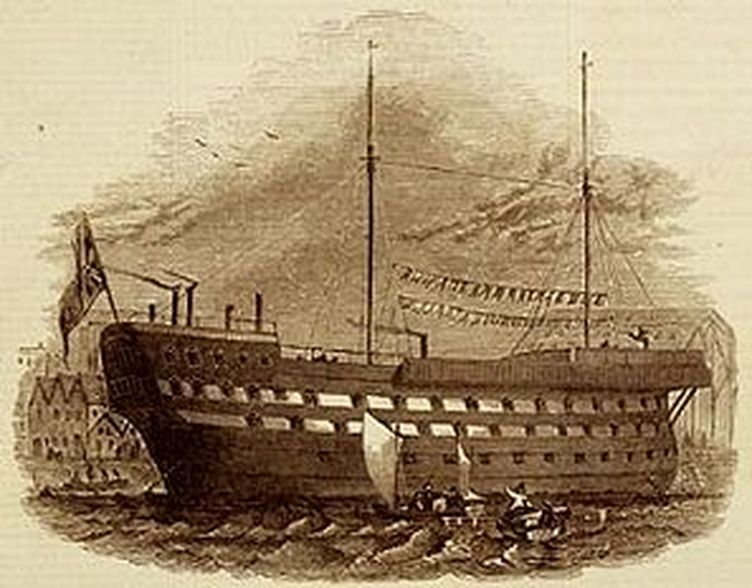
Transportation to America ended with the American War of Independence. This resulted in additional overcrowding of English prisons so a new solution needed to be put in place. In 1776 the Criminal Law Act (the Hulk Act) was passed allowing for prisoners to be housed in old ships, initially on the Thames at Woolwich. The convicts would be put to work to work on projects for the benefit of the navigation of the Thames.

Duncan Campbell was given permission to initially use two of his ships, the Justitia and the Censor to house the first prisoners. The Justitia, former convict ship, was the first ship used and when it was full the Censor also became a prison hulk. George Guest was transferred from Gloucester Gaol to the Censor to await transportation to Australia.

Initially there was little government supervision of the hulks.Campbell employed deputies and overseers to patrol the decks of the hulks and guard the prisoners. Food was scarce and of poor quality. This was a deliberate ploy as it was considered inappropriate that the prisoners appeared to be better treated than free people living in poverty. Conditions on the hulks were crowded and dirty. There was poor sanitation and diseases such as cholera, dysentery and typhus spread quickly. There was a high death rate on the hulks.

Image from Royal Museums Greenwich

The convicts on the hulks at Woolwich worked in chain gangs on projects relating to the Thames either in the dock yards or on the river banks. One of the tasks was to remove gravel and excess soil from the banks of the river.

The number of hulks increased and eventually were located at Deptford, Chatham, Gosport, Plymouth, Portsmouth, Sheerness and Cork as well as Woolwich. Duncan Campbell's contract to maintain his hulks was not renewed in 1802, but the hulk system continued until 1857. 

Fortunately George Guest remained on the hulk, Censor, only until February 1787 when he was transferred to the convict ship, Alexander, part of the First Fleet that arrived in New South Wales in January 1788.

Useful websites:

Duncan Campbell: the private contractor and the prison hulk - British Library Untold Lives blog

Convict hulks - Sydney Living Museum  

Convict hulks - The Digital Panopticon

Prison hulks - Royal Arsenal History

Prison hulks ( research guide) - National Library of Australia

Prisons & hulks (resources) - State Library of New South Wales

Thursday, 14 April 2022

The Old Gloucester Gaol

[Gloucester Castle keep: the old county gaol. Based on an 1819 work, from W. Andrew, ‘Old English Towns’, published 1909. Via Wikimedia Commons - Gloucester Crime History blog]

Brief history of the old gaol

The first gaol in Gloucester was in part of Gloucester Castle. The castle had been constructed early in the 12th century and part of it was in use as a gaol by 1185.

During the 17th century most of the castle was demolished but in 1672 the Sheriff of Gloucestershire insisted that the keep should be kept as the County Gaol.

By the late 18th century when George was a prisoner in the gaol, the building had become overcrowded and was in desperate need of repair. Some repairs were made between 1780 and 1782. The building was even fumigated in 1874.

In 1783 The Sheriff of Gloucestershire visited the gaol at the former castle keep and  recommended the building of a new gaol.

In 1784 an act was passed in parliament to make changes to the prison system including providing county magistrates the power to build their own prisons. William Blackburn drew up the plans for the new prison at Gloucester.

When plans for the new gaol were approved in 1785 the new building was to hold 207 prisoners.

In 1791 the first prisoners were transferred to the new building.

When George Guest (Gess) was an inmate of the prison between 1783 and 1786 the prison buildings were dilapidated and conditions for the prisoners were overcrowded, cramped, filthy, unhygienic and cold.  The prisoners had straw for beds which was rarely replaced. Food usually consisted of stale bread and pottage - a form of vegetable soup or stew which, on occasion, may contain small pieces of meat. 

There was one open sewer for the entire prison. Fleas, mites, lice and rats frequented the gaol. Disease was common in the gaol including typhus, also known as gaol fever. 

During the day the prisoners were usually put to work breaking rocks, picking oakum, beating flax or spinning yarn, making nails, mouse and rat traps, stools or garden tools. Groups of seven prisoners at a time could work the treadmill to grind corn and other cereals.

When considered necessary by gaolers, prisoners could be made to wear fetters and chains.

When the new prison opened in 1791 it was designed to hold 207 prisoners with separate sections for men and women. It also had exercise yards and a chapel. The prison was now under the jurisdiction of the Quarter Sessions.  Prisoners were now issued with prison clothes and even soap. The quality and quantity of food improved. Prisoners were also grouped according to their sentence rather than everyone being together. However by this time George Guest was in Australia.

Useful websites:

History of 1792 Old Gloucester Gaol - City and Country website

Gloucester Crime History - Prisons - blog (Jill Evans)

Conditions in Gloucester prisons - Gloucester Archives (article- pdf)


Tuesday, 29 March 2022

The Olympic Choir - Melbourne Olympic Games (part 1)

Recently I received an enquiry as to whether I had any additional information on the Olympic Choir that performed at the Olympic Games in Melbourne in 1956. Some years ago I gave a series of talks about my father's involvement as a sports journalist at the Olympic Games and at each talk people attending often provided additional information about involvement of their family members. At one of the talks I was given information about the Choir that sang at the Opening and Closing ceremonies.

The Official Report of the Organising Committee for the Games of the XVI Olympiad Melbourne 1956 provides come information about the Choir:

The Choir comprised members of the Royal Melbourne Philharmonic Society, City of Brighton Philharmonic Society, City of Camberwell Philharmonic Society, Royal Victorian Liedertafel, Myer Choral Society, Choral Association of Victoria and Melbourne University Choir, totalling 1,200 - sopranos, 600; altos, 200; tenors, 200, bases, 200. (page 226)

Opening Ceremony

The choir was placed in the main outer stand opposite the Royal Box and the rostrum. Immediately in front of the stand was a platform which accommodated the band of the Royal Australian Airforce under its Commanding Officer, Squadron Leader L H Hicks. The choir and band were conducted by Sir Bernard Heinze, Ormond Professor of Music, Melbourne University. The trumpeters of the Royal Australian Air Force band played also the Olympic fanfare for the raising of the Olympic flag. The fanfare was composed for the occasion by Squadron Leader Hicks. (page 226)

After the athletes from all the competing countries had entered the MCG during the Opening Ceremony, the Olympic Hymn was sung by the choir, accompanied by the band. The Dedication Address followed before the choir sang the Hallelujah Chorus. The flag bearers from competing countries formed a semi-circle around the rostrum where the oath was taken by John Landy. The National Anthem was played by the RAAF band and sung by the choir before the teams left the ground. (summary from pages 235-236) 

Closing Ceremony (pages 716 - 727)

An Australian Rules Football match was held on the MCG before the commencement of the Closing Ceremony. Before the football began the choir and the RAAF band were placed in the position they had occupied for the Opening Ceremony.

 During the Closing Ceremony the Olympic Hymn was sung by the choir while the Olympic flag was lowered. As the athletes left the ground the choir sang the Song of Farewell. Athletes from all nations inter-mingled, some of them walking rather than marching out of the vast Stadium to the lingering lilt of the old bush air and its cry of Good-bye Olympians followed by Will ye no' come back again?, taken up, still with emotional tremor in their voices, by the scores of thousands of spectators. 

Sir Bernard Heinze had suggested that the words of Waltzing Matilda should be adapted for the Song of Farewell (page 716).

Homeward, homeward, soon you will be going now;
Momok wonargo ora go-yai,
Joy of our meeting, pain of our parting,
Shine in our eyes as we bid you good-bye.

Good-bye, Olympians; good-bye Olympians,
(On comes the evening, west goes the day.)
Roll up your swags and pack them full of memories,
Fair be the wind as you speed on your way.

Blessings attend you, Fortune befriend you,
All good go with you over the sea.
May the song of our fathers - 'Will ye no' come back again?'
Sing in your hearts thro' the years yet to be.

Come to Australia, back to Australia,
(Mist on the hills and the sun breaking through)
With the sliprails down and the billy boiling merrily,
Wide open arms will be waiting for you.

A digital copy of The Official Report of the Organising Committee for the Games of the XVI Olympiad Melbourne 1956  is available online

 The Olympic Choir - Melbourne Olympic Games (part 2)

Olympic Games, Melbourne, 1956

The Olympic Choir - Melbourne Olympic Games (part 2)

In June 2013 Lloyd Jenkins wrote an account of his memories of his experiences of being in the Melbourne Olympic Choir in 1956. Lloyd gave me a copy of his notes in 2019. Below is a summary of Lloyd's experiences with the choir.

Twenty-four year old Lloyd Jenkins was one of the ten members of the Ballarat Choral Society selected to take part in the 1,200 member Melbourne Olympic Choir. Lloyd was one of the younger choir members. Choir members were expected to attend the four rehearsals held in Melbourne over several weeks before the Games began. Lloyd  travelled from Ballarat to Melbourne on a 1952 BSA 250 motor cycle.

The first rehearsal was at Wilson Hall, Melbourne University. The choristers sat in blocks - 600 sopranos, 200 contraltos, 200 tenors and 200 bass. On arrival they were told the pieces that would sing at the Opening and Closing ceremonies and eventually the appropriate sheet music was distributed. The choristers were also told that attendance at rehearsals was compulsory and a cardboard choir pass was issued with holes to be punched in it at each rehearsal. Squadron Leader Laurie Hicks was the rehearsal leader.  Eventually the choir would sing with the RAAF band but for this rehearsal they were accompanied by a pipe organ. At the first rehearsal the choir learned the Olympic Hymn.

Rehearsal number two was held at the Royal Exhibition Building where the choir members were seated on raked seating and were accompanied by an electronic organ. At this rehearsal the choir rehearsed the five items to be sung at the Olympic Games - God Save the Queen, the Halleluja Chorus, the Olympic Hymn, Waltzing Matilda (with new words) and Will Ye No Come Back Again?.

Back to the Exhibition Building on 9th November for rehearsal number three and this time the choir was able to practise with the RAAF band.To quote Lloyd, 'A choir of that size with a full sized Concert Band performing indoors makes an amazing sound.' For Lloyd, this rehearsal 'was the high point of the whole Olympic Choir experience... The sound within that building was unforgettable.'

On Sunday 18th November the fourth and final rehearsal was held at the MCG. This time 'Sir Bernard Heinze took the podium, a small platform there on the grass, facing the Band and the Choir.'  As Lloyd noted, 'the singers needed the experience of performing in that particular setting, mainly to build up confidence at pressing on against their own amplified sound from around the whole complex'. This rehearsal was not just for the band and the choir - 'the sound engineers and radio broadcast teams needed the experience as well'.

Thursday 22nd November 1956 was a warm sunny day in Melbourne - perfect for the Opening Ceremony. For Lloyd, 'perhaps the biggest moment was to see Australian Junior Mile Champion, Ron Clarke, enter the arena carrying the Olympic torch.' In summing up the day he concluded that the '110,000 spectators, and athletes, and the various officials and performers all had a day to remember forever.'

However it was the Closing Ceremony that created the greatest impression on Lloyd. 'If the Opening Ceremony was memorable, what about the amazing Closing Ceremony. The word amazing is not used lightly. Something happened at the Closing Ceremony that was not predicted. How could it have been predicted!. Neither could it have been orchestrated. It was spontaneous, a product of mass emotion.'

Traditionally at opening and closing ceremonies, teams entered and left the arena as separate nations however in Melbourne at the Closing Ceremony the athletes entered the stadium mixed together. They left in the same manner, walking, not marching. 'As the athletes left, the choir was singing its way through Waltzing Matilda and Will Ye No come Back Again?, two songs of farewell. 

We went straight from one into another, no break at all. Not all the athletes had left the Arena when the two songs were completed.' The conductor signalled for the songs to be repeated. As the words to the songs were printed in the  programme, 110,000 spectators gave full voice to their emotions as they sang with the Choir and the Band. 'A huge wave of emotion swept across the Stadium as the people sang and waved, and as the athletes marched and sang and waved.' 

'Magic moments like that take on a life of their own and any person who was there that day will understand what I am trying to describe' concluded Lloyd.

This account by Lloyd Jenkins of his experience of being a member of the Melbourne Olympic Choir at the Olympic Games in Melbourne in 1956 demonstates the ability of the power of music to add to the atmosphere of an event.

The Olympic Choir - Melbourne Olympic Games (part 2)

Olympic Games, Melbourne, 1956

Saturday, 11 April 2020

The First Fleet leaves Portsmouth

One of the projects during this period of social / physical isolation is to begin compiling information about the family history. Last term my seven year old grandson was asking questions about the convicts when he discovered that we have twelve convicts in our family including two who came on the First Fleet.
Today I decided to revisit the database, British Library Newspapers, which can be accessed from the website of the State Library of Victoria by those with a library card. Other major libraries will probably provide a similar service. The database provides access to digitised copies of articles published in Britain from the 1700s.

I used the advanced search option allowing me to search for a variety of terms such as "Botany Bay" and "Portsmouth" or "Botany Bay" and "Convicts" or just "Botany Bay" and restricting the time period of the search using the dates between option. I experimented  with a number of options.


Clicking the images below will provide a larger image.

On the surface the departure of the First Fleet for Botany Bay did not create much interest in the local press but aspects of the story can be discovered by exploring references to the departure of the ships during 1787.
 

The First Fleet left the Motherbank, Portsmouth, on 13 May 1787. From the beginning of the year convicts had left the gaols in which they had been imprisoned and loaded into wagons for the journey to Portsmouth. The Chelmsford Chronicle March 2 1787 carries a short report from the House of Commons, 26 February 1787.

 
On 7 May 1787 the Hampshire Chronicle added the following information about new convict arrivals aboard ships.
The following information about the ships at Portsmouth was provided on March 19 1787 in the Hampshire Chronicle. The paragraph in Home News listed the names of the ships that would be sailing to Botany Bay and also noted the captains of each ship and number of convicts and others on the vessels.

The Norfolk Chronicle reported on May 12 1787 that the fleet was ready to sail the next day.


A report dated 13 May appeared in the Northampton Mercury May 19 1787 that the ships had sailed that morning. The frigate, Hyaena, was to accompany them for the first part of the journey.
 The Hereford Journal May 17 1787 announced that the ships had sailed for Botany Bay.
A report on the initial progress of the fleet appeared in the Norfolk Chronicle May 26 1787 providing a quote forom a letter from Plymouth dated May 16.
Another short report in the Leeds Intelligencer May 22 1787 provided the coordinates of the ships when last sighted.
Over the ensuing months the newspapers provided information about the progress of the fleet either when a ship arriving in England reported a sighting of the ships or carried letters from First Fleet ships' officers.

The Hyaena brought a letter from an officer of the Friendship dated 20 May. A summary appeared in the Northampton Mercury 9 June 1787.

  Another report appeared in the Northampton Mercury June 30 1787.
The Hampshire Chronicle 30 July 1787 published part of a letter dated June 5 from Teneriffe written by an officer.
The ships of the First Fleet arrived in Rio de Janeiro in August to restock the food supply. This information appeared in the Stamford Mercury November 30 1787.

These snippets of information provide useful information on the commencement of the First Fleet voyage.

Saturday, 11 January 2020

2019 in review

2019 was a quieter year for family history research and resulted in only nineteen posts in my blog however quite some time was spent doing background reading and online courses on Future Learn which should help when writing family stories.

My Resolutions blog post at the end of 2018 listed a number of aims for the year - some of which I completed, some I started and some will have to go on the To Do List for 2020.

In 2018 I undertook the #52Ancestors in 52 Weeks challenge but left undone topics for eight weeks in the middle of the year as we were overseas. I did write those posts in 2019 so that is one tick.

I also wrote that I was going to concentrate on organising my collection starting with purchasing new storage boxes from Archival Survival. Ten boxes have been assembled and await my attention near my desk. This is a definite project for the new year combined with plans for reorganising the computer room now that the cot that has been in the room for nine years is no longer required for grandchildren. There will also be more space when boxes of toys are stored in another room. The plan is to have new shelves to hold my boxes, books relating to my family history plus folders. Having the material in one place should make finding material more efficient, especially as this would be the perfect excuse to sort items properly.

One aim was to write posts about musicians in the family and I wrote a two on that topic (although one was published on New Year's Eve 2018). I also wrote several posts on sport - one on the Stawell Gift which my father attended annually. Towards the end of the year, on two occasions, I repeated a talk that I first made three years previously about my father's involvement reporting on the Melbourne Olympic Games. Discussion at these talks resulted in the compilation of two more posts on this topic.

A number of history based television shows during the year provided background material on ancestors who lived many centuries ago. The SBS series, The Rise of the Clans, hosted by Neil Oliver had two episodes on Robert the Bruce and his family.  The End of Empire: the Rise and Fall of Dynasties on the History Channel was about the Saxon king, Edgar, who is credited with being the first King of All England. Another episode in this series was about Charlemagne - a topic for another occasion. The Family Legend prompt in the #52Ancestors challenge allowed for a post on  the branch of the family tree with the royal connections.


Events relating to 50 year anniversaries in our lifetime formed two more posts plus a post on significant trees in family gardens.

I have also read a number of books during the year, many of them relating to events in my family history.


In 2019 I took out an unlimited subscription to Future Learn online courses for a year and had a wonderful time exploring courses primarily relating to history and archaeology but also literature, health and even science. I also spent some time exploring the Italian language as two of my grandchildren learn Italian at school.

The University of Strathclyde ran three excellent online courses towards the end of the year 
Working lives in the Factories and Mills: Textile History and Heritage
Working Lives in the Coalmines: Mining History and Heritage
Working Lives on Britain's Railways: Railway History and Heritage. 
(With family who worked in the textile industry and in the railways, these will be very useful).

Lancaster University 
Lancaster Castle and Northern English history - more family connections. 
Humphry Davy (invention of the miners' lamp and other scientific discoveries).

University of Glasgow 
The Scottish Highland Clans: Origins, Decline and Transformation. This course complemented The Rise of the Clans television series. 
Early Modern Scottish Paleography
The History of Royal Fashion (the last 500 years).

University of Edinburgh 
Bonnie Prince Charlie and the Jacobites
How to Read a Novel (a look at modern fiction)

British Film Institute 
The Living Picture Craze: an Introduction to Victorian Film

University of Aberdeen 
Walter Scott: the Man behind the Monument

Royal Holloway, University of London 
Beyond the Ballot (the campaign for women's right to vote in Britain).
Peterloo to the Pankhursts: Radicalism and Reform in the Nineteenth Century.

Trinity College, Dublin 
The History of the Book in the Early Modern period: 1450 to 1800. 
The Book of Kells.

University of Groningen 
The Scientific Revolution (how seventeenth century science shaped the modern world)

University of Exeter 
Empire (debate about the British Empire)

University of Newcastle (Australia)
 Great Southern Land: Introducing Australian History

National Maritime Museum 
Confronting Captain Cook - Memorialisation in Museums and Public Spaces

University of Reading 
Rome (exploring the ancient city using 3D models)
Archaeology (this was one of the first courses that I did some years ago)

Durham University 
Archaeology and the Battle of Dunbar 1650: From the Scottish Battlefield to the New World.  
Forensic Archaeology and Anthropology.

Griffith University 
Written in Bone: an Introduction to Forensic and Bioarchaeology. 
A Question of Time (what dating fossils can tell about evolution).
Music Psychology: Why does Bohemian Rhapsody feel so good?

Monash University - Food as Medicine

Other Future Learn history related courses that I have done in other years include:
Lancaster University
Radical Spirituality (new seventeenth century religions including Quakers)

University of Southampton
Agincourt 1415

Newcastle University (UK)
Hadrian's Wall: Life on the Roman Frontier

University of Leicester
England in the Time of King Richard III

Monash University
World War I: A History in 100 Stories

UNSW Canberra
World War 1: Lessons and Legacy of the Great War

Trinity College, Dublin
Irish Lives in War and Revolution

Future Learn has courses on many topics so it is well worth exploring to see if there is anything of interest. If you just want to do a course and don't want access to the material after the conclusion of the course, there is no charge. This year I decided to pay the annual fee for additional access to the material, allowing me to refer to some of the topics as required.

Last year I was asked why I didn't join U3A. My reply was that I didn't need to as I have Future Learn

It has been an interesting year exploring a wide variety of topics, however this year my resolution is to concentrate on writing at least part of the family story for my family.

Saturday, 16 November 2019

Melbourne Olympic Games - 1956

I recently gave two more talks about the Melbourne Olympic Games where I have met many people with memories and family involvement with the games.

When I showed a slide of a picture of the Opening Ceremony on the cover of the Australian Women's Weekly a gentleman at one talk asked me to stop at the picture and pointed out two white squares in the picture. The two white squares are the Melbourne Olympic Choir.

He was a member of a combined community choir - the Melbourne Olympic Choir - that sang at the 1956 Melbourne Olympic Games. Lloyd gave me notes that he had written about his experiences with the choir which consisted members of community choirs throughout Victoria. As well as singing at the Opening Ceremony the choir performed at a number of events including the Closing Ceremony.

Other people at the meeting were Betty who, as a member of the St John's Ambulance Brigade, attended many of the events working with that organisation.
Museum of Applied Arts and Sciences
Presentation books showing pictures of Melbourne and surrounding areas were presented to members of the Olympic Committee who would eventually vote for the city to host the 1956 Olympic Games. Three special invitation books with lambs’ wool covers decorated with jewels were presented to three people including the King of England and the President of the OIC. Other copies were also covered with lambs’ wool and decorated with an enamelled emblem. Copies were also covered with suede plus enamelled emblems. The books were presented to member of the International Olympic Committee in 1948 and also to local supporters of the project. The company that printed the books was Spicers & Detmold in Coburg and one of the ladies present at the meeting was a daughter of one of the printers who made the books.
A copy of the book with the invitation
The Melbourne Invitation Committee extends a most cordial invitation to the esteemed International Olympic Committee to celebrate the XVI Olympiad in Melbourne, Australia, in 1956. 
A second book, published as a supplement to the first book, was published in January 1949 and was posted to all delegates of the Olympic Committee who would decide who would host the Games in 1956.
 
Another lady told us that her mother helped make the presentation cushions used for medal presentations at the Melbourne Olympic Games.
 
Official Report of the Organising Committee for the Games of the XVI Olympiad Melbourne 1956

When we were discussing who attended any events at the Olympic Games one couple laughed and the husband said that he went to the Closing Ceremony because the soccer final was played before the ceremony and he is a soccer fan. Meanwhile his wife stayed home and looked after the baby.
Program for the Closing Ceremony
Another connection to the Melbourne Olympic Games was one lady who said that she trained in athletics with Betty Cuthbert. At the Melbourne Olympic Games Betty Cuthbert won the 100m and 200m and was in the Australian 4 x 100m relay team which also won gold.
Marlene Matthews with Betty Cuthbert
The water polo incident in the Hungary and Russia  match was also mentioned in the game. The book by Harry Blutstein, Cold War Games, covers this unfortunate incident. This incident was later referred to as 'blood in the water'.
Blood in the Water
At the second talk the father of one lady was involved in the printing of the tickets for the Melbourne Olympic Games.


The three talks that I have given have provided additional information about the Melbourne Olympic Games.

Saturday, 28 September 2019

Olympic Games 1956 - more memorabilia

In preparation for another talk about the Olympic Games held in Melbourne in 1956 I now have some more memorabilia relating to the Melbourne Games and to my father.

Journalists reporting on the Melbourne Olympic Games were issued with a pass allowing them entrance to all venues during the period of the Games.
The Olympic Village Official Information Book provides basic information about the accommodation for those those staying at the Olympic Village in Heidelberg.
Click on image to enlarge
The information in this booklet provides examples of living in the 1950s with instructions for the use of bath heaters, gas coppers and other appliances. I also thought that it was interesting that steam irons and washing machines were only available in the Women's Quarters.
The Official Guide to the Olympic Games was published by the Organising Committee for the Melbourne Games. The guide contained a brief history of the Olympic Games, information about the Modern Games , venues, a programme of events, ticket prices, maps of venues plus information for tourists including information about transport, restaurants, sights to see, banking, postage etc.
The 1956 edition of The A T F S Olympic Handbook produced by the Association of Track and Field Statisticians was the third edition of this publication. It contains the official world track and field records for events from 1896 until 1952 as well as an all time world list for athletic events stating name,time, place and date event occurred. There is also  list if the world's best performances of all time.
The General Rules and Special Sports Regulations for the XVI Olympiad is a well used publication in my father's collection. It contains a detailed program for all events, maps (including gradients) for events held outside stadiums, general rules relating to the staging of the Games plus detailed regulations for individual sports.
The Melbourne Olympic Games were held from Thursday 22 November to Saturday 8 December. No events were held in Sundays. Programs were produced for each event for each day of competition. So far we have found programs for swimming, cycling and boxing among Dad's collection. I am still looking for the Dad's copy of the program for the Opening Ceremony.
In 1957 a booklet containing Australian Team Reports of the Olympic Games Melbourne 1956 was published. As well as lists of officials there was a general summary report followed by more detailed reports, often with photographs, for individual sports. There was a list of all the Olympic champions for the Games plus a list of Olympic placings by Australian representatives since the first Olympic Games in 1896.


These items, together with information on other posts on the Melbourne Olympic Games in this blog, help tell part of the story of an important sporting event in Melbourne's history.

Thursday, 26 September 2019

Abbey Road Beatles Album - 50 years on

Fifty years ago Abbey Road, the famous album by the Beatles, was released. This eleventh studio album by the Beatles was released on 26 September 1969. The album took six months to record and was final album that the Beatles recorded together.

Tracks on the album include:

Come together

Something

Maxwell's silver hammer
Oh! Darling
Octopus's garden
I want you (She's so heavy)
Here comes the sun
Because
You never give me your money
Sun King
Mean Mr Mustard
Polythene Pam
She came in through the bathroom window
Golden slumbers
Carry that weight
The end
Her Majesty (a hidden track)

The record studio, Abbey Road Studios, where many of the tracks were recorded located at 3 Abbey Road, may have contributed to the naming of this album but the photo of the four Beatles crossing Abbey Road on the zebra crossing has become an iconic image always associated with the album.

Visitors to the area have their photo taken crossing the Abbey Road crossing. Hopefully local traffic has become accustomed to this activity. Last year when the Australian Over 70s Cricket Team visited Lord's Cricket Ground many members of the team had a go at crossing Abbey Road.
John and Robin crossing Abbey Road
The photo used on the cover of the Abbey Road album.
Image from udiscovermusic
The music of the Beatles recorded in the 1960s continues to be popular, particularly among those of us who were teenagers at that time. The group holds an important place in the history of modern music.The record album, Abbey Road, remains a featured album in many music collections throughout the world.


Why the Beatles Abbey Road album was streets ahead of its time - udiscovermusic (includes links to music tracks on Spotify - need to log in)
Abbey Road Album Cover: Behind the Beatles most famous photograph - udiscovermusic

Sunday, 21 July 2019

Where were you during the first moon walk?

Image result for moon landing 1969
Man walks on the Moon July 1969 - National Geographic (July 2016)
Lunchtime on July 21 1969 (Australian time) Neil Armstrong was the first person to step on to the surface of the moon. This event was televised and watched by millions of people throughout the world.

NASA had three tracking stations prepared to monitor and record images of the moon walk - at Goldstone in California, Madrid in Spain and Honeysuckle Creek in New South Wales. These Apollo tracking stations were spaced at equal distances around the globe and between them could cover what was occurring on the moon. Also in New South Wales was the Tidbinbilla tracking station which had the role of tracking the lunar module while Honeysuckle Creek tracked the command module when they were being operated separately. Later the radio telescope at Parkes was added to the Australian network by NASA. Although the radio telescope could not transmit information it had a much larger dish - 61 metres compared with 26 metres - making it useful for receiving information from space.

There had been much discussion as to whether the moon walk would be televised, particularly as cameras were heavy, but in June it was decided that the event should be filmed. A lighter camera had been produced and was stored in an external tool locker. The position of the camera meant that images were filmed upside down, however NASA had an inexpensive device that allowed them to invert the images before transmitting them to the world.

Just before 1 pm (AEST) Neil Armstong made his way to the capsule door and began the slow descent to the surface of the moon. At this time the camera began to film the historic event. Honeysuckle Creek began relaying images to Houston and Goldstone also had images. NASA wanted to transmit the images from Goldstone but there was a problem so they had to use the images from Honesuckle Creek. There was an initial delay but then the world received images of Neil Armstrong nearing the final rungs of the ladder before stepping on the moon and making the famous statement - One small step for man. One giant leap for mankind. Shortly afterwards the clearer images from Parkes were used for the remainder of the moon walk.

Meanwhile people throughout Australia (and the rest of the world) were watching the events on television. I was working at Civic Branch Library in Canberra in Civic Square. We did not have access to television but a shop in a nearby street had put a television set in its front window allowing people passing by to view what was happening on the moon. Needless to say there was quite a crowd watching.  Fortunately it was quiet in the library so staff took it turns (usually two at a time) to join the crowd watching the moonwalk. We could therefore say, 50 years later, that we had seen Neil Armstrong walk on the moon.

Last week I asked my husband where he was during the moonwalk. He was a science student at Melbourne University and the university had organised screenings of the event in several lecture theatres so that students and staff could watch .

National Geographic article 19 July 2016 - One giant leap for mankind

'The real dish story' in The Age 20 July 2019