Showing posts with label George Guest (1765-1841). Show all posts

Friday, 15 April 2022

Prison Hulks

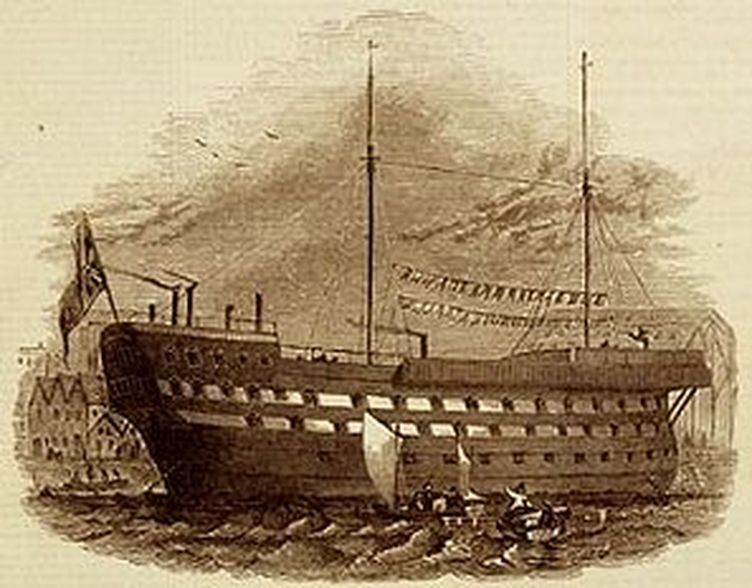
Transportation to America ended with the American War of Independence. This resulted in additional overcrowding of English prisons so a new solution needed to be put in place. In 1776 the Criminal Law Act (the Hulk Act) was passed allowing for prisoners to be housed in old ships, initially on the Thames at Woolwich. The convicts would be put to work to work on projects for the benefit of the navigation of the Thames.

Duncan Campbell was given permission to initially use two of his ships, the Justitia and the Censor to house the first prisoners. The Justitia, former convict ship, was the first ship used and when it was full the Censor also became a prison hulk. George Guest was transferred from Gloucester Gaol to the Censor to await transportation to Australia.

Initially there was little government supervision of the hulks.Campbell employed deputies and overseers to patrol the decks of the hulks and guard the prisoners. Food was scarce and of poor quality. This was a deliberate ploy as it was considered inappropriate that the prisoners appeared to be better treated than free people living in poverty. Conditions on the hulks were crowded and dirty. There was poor sanitation and diseases such as cholera, dysentery and typhus spread quickly. There was a high death rate on the hulks.

Image from Royal Museums Greenwich

The convicts on the hulks at Woolwich worked in chain gangs on projects relating to the Thames either in the dock yards or on the river banks. One of the tasks was to remove gravel and excess soil from the banks of the river.

The number of hulks increased and eventually were located at Deptford, Chatham, Gosport, Plymouth, Portsmouth, Sheerness and Cork as well as Woolwich. Duncan Campbell's contract to maintain his hulks was not renewed in 1802, but the hulk system continued until 1857. 

Fortunately George Guest remained on the hulk, Censor, only until February 1787 when he was transferred to the convict ship, Alexander, part of the First Fleet that arrived in New South Wales in January 1788.

Useful websites:

Duncan Campbell: the private contractor and the prison hulk - British Library Untold Lives blog

Convict hulks - Sydney Living Museum  

Convict hulks - The Digital Panopticon

Prison hulks - Royal Arsenal History

Prison hulks ( research guide) - National Library of Australia

Prisons & hulks (resources) - State Library of New South Wales

Thursday, 14 April 2022

The Old Gloucester Gaol

[Gloucester Castle keep: the old county gaol. Based on an 1819 work, from W. Andrew, ‘Old English Towns’, published 1909. Via Wikimedia Commons - Gloucester Crime History blog]

Brief history of the old gaol

The first gaol in Gloucester was in part of Gloucester Castle. The castle had been constructed early in the 12th century and part of it was in use as a gaol by 1185.

During the 17th century most of the castle was demolished but in 1672 the Sheriff of Gloucestershire insisted that the keep should be kept as the County Gaol.

By the late 18th century when George was a prisoner in the gaol, the building had become overcrowded and was in desperate need of repair. Some repairs were made between 1780 and 1782. The building was even fumigated in 1874.

In 1783 The Sheriff of Gloucestershire visited the gaol at the former castle keep and  recommended the building of a new gaol.

In 1784 an act was passed in parliament to make changes to the prison system including providing county magistrates the power to build their own prisons. William Blackburn drew up the plans for the new prison at Gloucester.

When plans for the new gaol were approved in 1785 the new building was to hold 207 prisoners.

In 1791 the first prisoners were transferred to the new building.

When George Guest (Gess) was an inmate of the prison between 1783 and 1786 the prison buildings were dilapidated and conditions for the prisoners were overcrowded, cramped, filthy, unhygienic and cold.  The prisoners had straw for beds which was rarely replaced. Food usually consisted of stale bread and pottage - a form of vegetable soup or stew which, on occasion, may contain small pieces of meat. 

There was one open sewer for the entire prison. Fleas, mites, lice and rats frequented the gaol. Disease was common in the gaol including typhus, also known as gaol fever. 

During the day the prisoners were usually put to work breaking rocks, picking oakum, beating flax or spinning yarn, making nails, mouse and rat traps, stools or garden tools. Groups of seven prisoners at a time could work the treadmill to grind corn and other cereals.

When considered necessary by gaolers, prisoners could be made to wear fetters and chains.

When the new prison opened in 1791 it was designed to hold 207 prisoners with separate sections for men and women. It also had exercise yards and a chapel. The prison was now under the jurisdiction of the Quarter Sessions.  Prisoners were now issued with prison clothes and even soap. The quality and quantity of food improved. Prisoners were also grouped according to their sentence rather than everyone being together. However by this time George Guest was in Australia.

Useful websites:

History of 1792 Old Gloucester Gaol - City and Country website

Gloucester Crime History - Prisons - blog (Jill Evans)

Conditions in Gloucester prisons - Gloucester Archives (article- pdf)


Saturday, 16 December 2017

Christmas Day Norfolk Island

Descriptions and events of Christmas Day on Norfolk island from 1788  to 1793.
George Guest and Mary Bateman arrived on Norfolk Island in 1790.

25 Dec 1788: Philip King wrote: The 25th, being Christmas-day, it was observed as a holyday. The colours were hoisted at sun-rise: I performed divine service; the officers dined with me, and I gave each of the convicts half a pint of rum, and double allowance of beef, to celebrate the festival: the evening concluded with bonfires, which consisted of large piles of wood, that had been previously collected for the occasion.

25 Dec 1789: Philip King wrote: Moderate breezes & pleasant Wr at Sunrise hoisted ye Colours in observance of Christmas Day. at 10 AM performed Divine Service killed 2 Hogs belonging to the Crown Wt 180 lb & issued them 1 lb & ½ to each person & as our Crop of Wheat has been a good one gave Them 2 lb of Flour each Man & one pound to the Women —

25 Dec 1790: Ralph Clark wrote: Fine weather but blows fresh from the Southward and a great Sea Rolling into the Bay which will make a great Surf on the Reef on which there is a great dele at present — this being Christmas day I wish a merry merry Christmas to all the world — the most poorest person in England will be better off this day than any of use here for the[y] will be able to get Small bier with their dinner to drink if nothing better and there is not any of use will have anything better but cool water this will be a dry Christmas — doe good Gorgon come and take use away from this place.

Philip King does not mention Christmas Day 1791 in his journal.

25 Dec 1792: Philip King wrote: Was observed as a Holyday and divine Service preformed. The good things that were purchased from the Philadelphia enabled everyone to pass this Festival, which much Conviviality and regular behaviour.

25 Dec 1793: Philip King wrote: Devine Service was preformed and kept as a Holyday.


Australian History Research website - Christmas Day Norfolk Island 1st Settlement

Thursday, 5 January 2017

Horse racing connections

University of Tasmania Family History course - Writing Family History

Week 3 e-tivity - The past interrupted
In this exercise we were asked to write about one moment in the lives of our ancestors. I chose to write about the first race meeting held in New South Wales in 1810. A great (x3) grandfather and a great (x4) grandfather, who probably did not know each other, both had horses taking part in the the three day racing carnival. E-tivities are restricted to no more than 250 words.

Horse racing connections

As we know, family history research can produce unexpected connections. What are the odds of having a third great grandfather and a fourth great grandfather both entering horses in the first race meeting in New South Wales? 

The race meeting at the new racecourse at Hyde Park was a great success attracting large, enthusiastic crowds who gathered to watch three days of racing. Governor Macquarie’s belief that horse racing would provide a place for all colonists to meet may therefore have indirectly impacted upon my family.

Among this crowd was Simeon Lord, a subscriber to the racecourse, who not only attended the races but also entered his horse, Tipsey, in the Ladies’ Cup. No doubt Simeon would have enjoyed watching his horse win the first two mile heat and being placed in the other two, though this effort was not sufficient to win the Cup. 

At the races Simeon may have met another race goer, George Guest, a resident of Van Diemen’s Land who frequently made prolonged trips to New South Wales. George had entered a horse to run on day three of the race meeting and I am sure would have attended the races on other days.

Simeon and George had different business interests and I doubt that their paths would have crossed prior to the race meeting but they certainly could have met at the races. We do know, however, that twenty years later the two families were permanently connected when Simeon’s son married George’s grand-daughter in Hobart.

References:
Posts on horse racing in this blog

NB Horse racing has continued to be an interest in many lines of the family story.

Monday, 31 October 2016

First race meetings in Australia

Melbourne Cup time again. In the past I have added a number of posts to this blog about family connections with the Melbourne Cup and with horse racing in general. Recently I came across articles mentioning Simeon Lord's connection with the introduction of horse racing in New South Wales.

The website of the State Library of New South Wales includes an archived online exhibition - Day at the races: the horse in Australia. In January 1788 five horses arrived in Australia with the First Fleet and by 1810 it was recorded that there were 203 horses in New South Wales. In the early days of the colony horses were rare and expensive and usually only owned by military officers or by free landholders. In October 1810, shortly after Govenor Macquarie arrived in New South Wales, the first official racing carnival was held at the Sydney racecourse, part of the newly created Hyde Park.
One section of the online exhibition states that 'Governor Macquarie inaugurated the first official race meeting at the new Sydney Racecourse. Macquarie saw the racecourse as a perfect neutral meeting place for colonists of all classes: military, convict, emancipist and immigrant.' The racecourse was constructed in August 1810 by members of the 73rd Regiment who came to New South Wales with Macquarie. They 'levelled ground on the eastern edge of the town and marked out the course. The straight commenced at the turn from Park Street into Elizabeth Street, with the grandstand (erected in 1813) and the winning post at the junction of Market and Elizabeth Street, on the present day site of St James Railway Station.' Funding for the project was provided by subscribers.

Searching newpapers in Trove provides details leading up to the first race meeting in Sydney. There is also information about a range of social activities associated with the race meeting.

The Sydney Gazette and New South Wales Advertiser 21 July 1810 page 1 has a notice about a meeting of the Subscribers to the Sydney Race Course to meet in the Mess Room of the Officers of the 73rd Regiment on Monday at 10 o'clock.

The Sydney Gazette and New South Wales Advertiser 18 August 1810 page 1 contains a report of a dinner attended by the Subscribers to the Sydney Racecourcse to celebrate the birthday of the Prince of Wales. A number of Toasts were drunk during the evening including to the King, the Queen, the Prince of Wales, the Duke of York and the rest of the Royal Family, Lord Mulgrave and the Navy, Sir David Dundass and the Army, His Excellency Governor Macquarie and the Colony, Mrs Macquarie the Patroness of the Races and the Ladies of the Colony, The Turf etc. The comment was made that 'the evening passed with the utmost convivitality and harmony'.
The report continued:
The RACES are fixed for Monday the 15th of October; and three plates of 50 guineas each will be run for during the week; exclusive of several bye-matches, subscriptions, &c.
This Establishment, altogether novel in this Country, bids fair to acquire celebrity and success from the judicious arrangements under which it has been projected, and the distinguished Auspices under which it has been brought forward, besides the advantages which the Country at large is likely to derive from the improvement of the breed of horses, an object, that in a rising Colony may be calculated upon as conducive to its internal interests and prosperity.
Lieutenant Governor O'CONNELL, Lieutenant Wright, and Mr. Williams are the Stewards elect for the present year.         
The following week John Reddington, the Clerk of the Course, issued a warning in The Sydney Gazette and New South Wales Advertiser 25 August 1810 page 1:
The Subscribers to the Race Course are requested not to ride the horses over it that they intend to enter for plates or subscriptions at the ensuing races,nor to suffer their servants to train them over it: Any horse that may be seen in training on the Course will not be allowed to start.--By order of the Stewards.
On 19 September a Bachelor's Ball was held by the Subscribers to the Sydney Race Course and was reported to have been a great success. The Sydney Gazette and New South Wales Advertiser 22 September 1810 page 2.

The Subscribers to the Sydney Race Course held another meeting in the Mess Room of the Officers of the 73rd Regiment on Monday 1 October. The Sydney Gazette and New South Wales Advertiser 29 September 1810 page 1.

Under the heading, A Card, the following notice appeared in The Sydney Gazette and New South Wales Advertiser 6 October 1810 page 3 - 'The Subscribers to the Sydney Race Course are informed, that the Stewards have made Arrangements for two Balls during the Race Week, Tuesday and Friday.--Tickets at 7s. 6d. each to be had at Mr. E. Wills's, George Street.'
On page 4 of the same paper - 'The Public are requested not to bring Dogs on the Sydney Race Course; any found thereon after this Notice will be Shot.'

A week before the racing carnival, The Sydney Gazette and New South Wales Advertiser 13 October 1810 page 2 reminded Subscribers about the two balls then added - 
An ORDINARY for the Subscribers and their Friends each Day of the Races at Mr. Wills's.- Dinner on Table at Five o'Clock.
On Monday the Races commence, and continue Wednesday and Friday. Horses to start each day at one. For general information on the subject of these elegant sports, a Racing Kalendar will be in readiness at nine on Monday morning.-Price 6d.
The Sydney Gazette and New South Wales Advertiser 20 October 1810 page 2 has a detailed  report of the three day carnival held at Sydney racecourse (Hyde Park) on Monday 15, Wednesday 17 and Friday 19 October. The report for the second day of the race meeting read:
A Cup, value 50 guineas, given by the Ladies of the Colony, for horses of all ages belonging to Subscribers of the Sydney Race Course. The best of 3 2-mile heats. Three year olds to carry 7 st. 4 lb. 4 year olds 8 st. 1lb. 5 year olds 9 st. 2 lb. and aged 10st.
Mr Lord's b. g. Tipsy (Tipsey) 2 yrs old          1 3 2
Mr Oven's ch. m. Bessie 2 yrs old                 2 4 drawn
Mr Williams' r. g. Strawberry 5 yrs old            3 2 2
Capt. Ritchie's gr. g. Chase 6 yrs old             4 1 1
Colonel O'Connell's bl. g. Carlo 6 yrs old        6 dr
Capt. Piper'sch. m. Miss Kitty aged               5 4 4
A good race between Chase and Strawberry the last two heats.
Mr. Wentworth'sb. g. Gig rode by Mr. Bayley, beat Mr. Broughton's bl. g. Jerry, rode by Capt. Ritchie, 3 miles, 40gs. - Gig won easy.
Additional information about the Ladies' Cup was provided:
The Ladies' Cup, which was of very superior workmanship, won by Chance, (Chase) was presented to Captain Ritchie by Mrs Macquarie; who accompanied by His Excellency, honoured each day's Races with her presence, and who, with her usual affability, was pleased to preface the donation with the following short address:
"In the name of the Ladies of New South Wales, I have the pleasure to present you with this Cup. Give me leave to congratulate you on being the successful Candidate for it; and to hope that it is a prelude to future success, and lasting prosperity"
Races at the racecourse at Hyde park continued until the early 1820s. However there were problems in maintaining the surface of the racecourse as shown in Sydney Gazette and New South Wales Advertiser 2 February 1811 page 2.
The Non-Subscribers to the Sydney races are hereby strictly forbid driving or riding Horses on the Course, without Permission of the Stewards. It is hoped the Subscribers will see the necessity of keeping on the outer Edge, when they drive or ride round the Course, as the Damage already done to it by Carriages driving near the Posts must be obvious to every person. ( By Order of the Stewards),
The original number of Subscribers was limited to 50 however in 1813 the suggestion was made to hold a ballot allowing gentlemen who were newcomers to the Colony the opportunity to also become Subscribers. Sydney Gazette and New South Wales Advertiser 17 July 1813 page 2. Another announcement in this issue of the newspaper stated:
None but Subscribers, or their authorised Servants, being entitled to ride on the Race Course, it is hoped that all other Persons will see the Propriety of avoiding the Course, during the Exercising Season, and thereby do away the Necessity for resorting to other Measures for the preserving the Course to its proper Object.
Gentlemen are requested to instruct their Servants not to ride on the Race Course unless for the Purpose of training, until after the Races, as those who are not in training interrupt the regular Exercise of the Horses destined for the public Amusement of the Race Week.
Simeon Lord's horse, Tipsey, was also entered in the race carnivals held in 1811 and in 1812.

On the first day of the three day race carnival in 1811-  held between 12 August and 16 August - Mr Lord's b. g. Tipsey 4 yrs old came second in the two heats of the Subscription Plate (value 50 gs).
Sydney Gazette and New South Wales Advertiser 17 August 1811 page 2.

 The following year when the races were held from 17 August to 21 August, Tipsey (now 5 years) was again entered in the Subscription Plate but, along with a number of other horses, was disqualified. The report added that despite the heavy rains experienced from the Monday to the Thursday, "the Course was much crowded".
Sydney Gazette and New South Wales Advertiser 22 August 1812 page 2.

The newspapers provide additional information about Tipsey.
A newspaper advertisement in February 1811 mentioned that two well known geldings, Strawberry and Tipsey, were available for sale. Sydney Gazette and New South Wales Advertiser 7 February 1811 page 2.

The following year the Sydney Gazette and New South Wales Advertiser 18 January 1812 page 4 reported:
Strayed from Burn's Farm at Botany Bay, about ten days since, a Bay Gelding, black legs, mane and tail, known by the name of Typsey, late the property of Mr. Lord, but now belonging to Major Geils. Any person finding the same and bringing him to Major Geils, will be handsomely rewarded. 
As Tipsey was being raced again by Mr Lord later in the year it would appear that Simeon repurchased the horse.

The book, Horsemen of the First Frontier (1788-1900) by Keith R Binney (2005) includes several pages about Simeon Lord including his involvement with horse racing. (pp148-150).

The Dictionary of Sydney has a short article on the Hyde Park racecourse.

The Australian Racing Report also includes an article on early days of racing in Sydney.

Note. At the end of the report (in The Sydney Gazette and New South Wales Advertiser 20 October 1810 page 2) about the three days of racing at the Sydney Racecourse in October 1810, the following information was also provided:
And afterwards Boshy's Hack ran against G. Guest's (Hack), a three mile heat, for 10gs - A good match, won by Boshy.
Reports in the Sydney Gazettee and New South Wales Advertiser show that George Guest was in Sydney for at least parts of 1810. It is therefore probable that he was the G. Guest whose horse raced Boshy's horse.
Saturday, 8 October 2016

George Guest at Risdon Cove - part 2

The State Library of Victoria has a number of books on the early settlement of Tasmania so I ordered some of them to try and discover where George Guest had his 300 acres of land at Risdon Cove.

I knew that the land was close to the original settlement so I started by looking at a work by Angela McGowan describing an archaeological dig of the area in 1978-1980.  From the excavation of several sites in the area McGowan describes a number of the structures from the original settlement. However it was on page 14 that I had my 'Eureka' moment when I found a sketch by Woodward of some of the landholdings in the area. To the right of the Risdon Brook was a rectangle identified as G Guest 300 acres.
McGowan page 14
On the other side of the brook the land was identified as belonging to W J Anson 300 acres. (William L'Anson was a surgeon who sold the land to Thomas Birch). In 1812 this block was sold to Andrew Geils, the person who tried to annex George Guest's land in 1813. Andrew Geils left Van Diemen's Land in 1814 but arranged for a series of agents to look after his interests.

Unfortunately I have found no further description of Guest's property. Phillip Tardif, however, provides a description of some of the buildings on Geil's property. "A two-storey brick house arose near what had been Moore's original garden, and a stone wharf at Bowen's original landing place. Geil's pride and joy were his 'Beautiful Gardens' he planted - with apple and peach trees, grapevines and oaks". Tardif then adds - "Stockyards, stock-keepers' huts and poultry houses were built also, but by costly error (for Geils) on the adjoining 300 acres owned by George Guest." (Tardif p192)

The Tasmanian Archive and Heritage Office (TAHO) has a series of county maps on the LINC website. The maps are series AF396 County Maps created by the Lands and Surveys Department. Risdon Cove was in the Parish of Forbes located in Monmouth, one of the twenty early land districts in Tasmania. AF396-1-256 is another map of the area around Risdon Cove. This map was surveyed by a surveyor named Seymour and also shows Guest's land.
A copy of the original map surveyed by Woodward is also available on this site as AF396-1-216.

There is still much to learn about this 300 acres of land and how it was farmed plus when it was actually sold. However an article in The Sydney Gazette and New South Wales Advertiser 21 January 1810 p2 provides an account by George Guest of the extent of farming near Hobart Town a year or two after he acquired his 300 acres at Risdon Cove.
From a Mr George Guest, a few days since arrived from the Derwent, we learn the following particulars relative to that Settlement, which may appear interesting. The ground under cultivation Mr. Guest considers to be about 1500 acres. The crop of wheat of the present year's growth he considers will scarcely average eight bushels to the acre, owing to the seed, which was mostly sent from hence, having been of a very indifferent quality. Sixteen acres of Mr. Guest's own growth, he scarcely imagines will produce three bushels to the acre. The flock of horned cattle is in very good condition, and the prices of articles are much similar to those with us; fresh beef, mutton and pork being 1s. 6d. per lb.; potatoes 2d. per do; fowls dear, being from 5 to 6s. each; tea 8 to 12s. per lb.; sugar 10d. per do; spirits 15 to 16s. per bottle; and the store price of wheat 21s. per bushel before the Union arrived. The different settlements of agriculture are New Norfolk, 25 miles from Hobart Town, on the banks of a fine fresh water river, navigable at high water to a vessel of the Lady Nelson's burthen; the next we notice will be Herdsman's Cove, about mid-way between Hobart and the above; — This has only been settled a few months since by settlers from Norfolk Island, who have not yet been able to plant any thing but potatoes; — the river gets brackish at high water. The next is Kangaroo Point about two miles from the town but on the opposite side the river, well watered by a very fine run; and about a mile more distant from Hobart is New Town, which was the first settlement made. Ralph's Bay is about eight miles from Hobart, and also on the opposite shore of the river. Here from 130 to 200 acres are in cultivation by the Norfolk settlers; about 200 of whom have at different times been removed thither with their families, amounting to 1100 persons more or less. The land near the town is considered some of the best yet cultivated, and is mostly laid out in gardens, which produce vegetables in tolerable abundance.
References:
Glover,Margaret. 1978. History of the Site of Bowen’s Settlement, Risdon Cove. Hobart, National Parks and Wildlife Service Tasmania Occasional Paper No. 2.  [SLTF 994.61 G51H]

McGowan,Angela. 1985. .Archaeological Investigations at Risdon Cove Site 1978-1980. Hobart, National Parks and Wildlife Service Tasmania Occasional Paper No. 10. [SLTF 994.61 M17A]

McPherson,Kaye. 2001. Risdon Cove from the Dreamtime and the First Hundred Years. Lindisfarme, Manuta Tunapea, Puggaluggia.  [SLTF 994.61 M24R]

Tardif, Philip John. 2003. John Bowen’s Hobart: the Beginning of European Settlement in Tasmania. Hobart, Tasmanian Historical Research Association. [LT 994.6102 T17J]

George Guest at Risdon Cove - part 1

George Guest (1753-1841) and his family arrived in Hobart Town in September 1805 from Norfolk Island. The decision had been made to close the settlement on the island and George and his family were among the first to leave. However as George had a number of land holdings on Norfolk Island, a house and livestock, he left Norfolk Island on the understanding that he would be fully compensated for the land surrendered. George did receive a number of grants of land but, feeling that he never received full compensation for his Norfolk Island land, he spent many years petitioning for full compensation.

Earlier in the year I investigated the location of the Seven Stars inn in Campbell Street once owned by George Guest. When I visited Hobart last year I also visited the location of land in the area of what is now Macquarie Point which was the first land granted to George Guest in January 1806. As mentioned in the previous post my next goal was to locate the location of 300 acres of land granted to George Guest, probably in 1806, in or near Risdon Cove. Previous research in the Historical Records of Australia (HRA) had located reference to George owning 300 acres in the Risdon area.

On the 27th January 1806 Lieutenant-Governor David Collins wrote a letter to Governor King in Port Jackson informing him of what he had done so far in assisting George Guest settle into the new colony. George Guest had brought sheep with him from Norfolk Island. Not all survived the trip but some were kept by George while the remainder were purchased by the government at £3 per head. George was also allowed to land thirty-seven gallons of spirits for his own use. George Guest was under the impression that he should receive 424 acres of land in the new colony. The land at Fosbrooks (later Macquarie) Point was twenty-four acres. At one stage it was decided that George Guest would receive the rest of the land as four allotments of 100 acres and Collins reported that he had told George Guest to choose suitable land. However George then decided to remove his family to Port Jackson where his children could receive an education. George sold a yoke of oxen (two oxen) and some other animals but announced that he would return to claim land in Van Diemen's Land. He had also provided the government with a quantity of provisions including salted pork, flour and sugar in exchange for twelve cows and one calf. George Guest and his family were to travel to Port Jackson aboard the Sophia and would receive full victuals for two weeks. The letter concluded with the statement that "I understand he purposes returning at some (not very) distant Period to occupy his Farms, which he has now chosen in one allotment in the Neighbourhood of Herdsman's Cove." (HRA series III vol 1 pp354-355)
Map showing Herdsmans Cove (top) in relation to Risdon Cove (middle)
The map above shows Herdsmans Cove in relation to Risdon Cove. (Tardif) Subsequent references to the 300 acres of land belonging to Geoge Guest all provide Risdon Cove as the location.

The original European settlement on the Derwent River had been at Risdon Cove from 1803 until 1804 when Collins decided to establish the settlement of Hobart Town across the river. In February 1805 Lieutenant-Governor Collins wrote to Governor King that he had decided to open a Government Farm at Risdon Cove but some allotments could be made available for settlers. (HRA series III vol 1 p317).  A follow-up letter in October 1805 described how land in that previously cultivated area had been tilled again and replanted with barley and wheat. Collins had expectations of "an abundant produce from the ensuing harvest". (HRA series III vol 1 p331) When Collins travelled to Australia via the Cape of Good Hope he had brought with him "Cape Seed" which grew better in the new colony than the seed from England. (HRA series III vol 1 p248) The plan for a Government Farm at Risdon Cove appears to have been short lived but the area was made available to new settlers arriving in the colony to farm. George Guest would appear to have been one of these settlers.

The returns of the General Muster 1809 show that George Guest was a settler at Risdon Cove, Clarence Plains, where he owned 300 acres of land. He was farming twenty acres of wheat, had 63 cattle, 49 sheep and 1 pig. (Shaffer p54)

In April 1813 Governor Maquarie wrote a letter to Major Geils making it clear that Geils had no right to assume the 300 acres of land belonging to George Guest as part of Geil's property at Risdon Cove. Governor Maquarie stressed that Guest's land had "been regularly assigned to him and taken possession of by him in part Payment of his Norfolk Island Claims on Government." (HRA series III vol 2 pp30-31).  Geils had tried to add the land to his property arguing that Guest had left his property to go to New South Wales.  Advertisements in  newspapers located via Trove show, George Guest was regularly travelling between Van Diemen's Land and Port Jackson at this time. Macquarie told Geils that the only way that he could aquire the land was to purchase it directly from George Guest. George Guest kept possession of the 300 acres at Risdon as shown by an advertisement in the Hobart Town Courier 24 November 1827 advertising the Risdon land for sale or let.

When we visited Hobart last year we had passed Risdon Cove when we travelled via the ferry to MONA. We did visit other locations in Clarence including Bellerive and Kangaroo Bay but did not visit the Risdon Cove area. The need to create a research plan for an Introduction to Family History course provided the impetus to try and locate the actual location of George's 300 acres.

References:
Historical Records of Australia (HRA) series III Despatches and Papers Relating to the States. vol 1 & 2

Schaffer, Irene (ed). 1991. Land Musters, Stock Returns and Lists. Van Diemen’s Land 1803-1822. Hobart, St David's Park Publishing.

Tardif, Philip John. 2003. John Bowen’s Hobart: the Beginning of European Settlement in Tasmania. Hobart, Tasmanian Historical Research Association.

Advertisement. The Sydney Gazette and New South Wales Advertiser 21 January 1810 p1; 2 February 1811 p2; 18 July 1812 p1; 20 March 1813 p2; 16 October 1813 p1; 4 March 1815 p2; 14 December 1816 p2; 29 November 1817 p4; 18 April 1818 p1; 26 December 1818 

Advertisement. The Hobart Town Courier 24 November 1827

Monday, 3 October 2016

Family History Research Plan

The major assignment for the Introduction to Family History course at the University of Tasmania was to create a Family History Resarch Plan. I took the opportunity to decide how I might locate a map showing where George Guest had land at Risdon Cove. The research plan proved a useful exercise leading me to locate the information I was seeking. I will write about this part of George's story in another post.

Genealogical problem:
(Introduce the key focus of your research plus a clearly stated research question)
 
Visiting Hobart last November I spent time exploring, on foot, the area where three of my ancestors had land in Hobart prior to 1840 including the area on Fosbrooks (later Macquarie) Point that originally belonged to George Guest. George Guest also owned the Seven Stars Inn on Campbell Street. Since then I have been looking for information about other holdings of land owned by George Guest in Tasmania.

George Guest (1765-1841) was my great (x4) grandfather. In 1783 he was arrested for stealing pigs and a horse. George Guest was a First Fleet convict who travelled to Norfolk Island in January 1790. In September 1805 George and his family relocated to Hobart Town. While on Norfolk Island George became a major land owner and farmer and understood that when he left Norfolk Island he would be compensated with grants of land on his arrival in Van Diemen’s Land. George received some land grants but was to dispute whether this was fair compensation for the rest of his life.

The initial settlement on the Derwent was at Risdon Cove in 1803 before being relocated to the present site of Hobart in 1804. Prior to the relocation some of the land at Risdon Cove had been cleared for farming and Lieutenant-Governor Collins later provided seed for the planting of crops. When the settlers decided to return to Sydney the land was intended to be used as a government farm. There was a need for a reliable supply of grain for the new settlement so land in the Risdon Cove area was made available for farming. In January 1806 George Guest was considering a grant of 300 acres of land in the Herdsman’s Cove area near Risdon Cove though later references show that the land grant was at Risdon Cove. By 1809 twenty acres of the land was farmed for wheat and George had 63 cattle and 49 sheep.

George Guest made many trips to New South Wales where he also had some land but his main landholdings were in Van Diemen’s Land. In 1813 a neighbour, Major Geils, attempted to add George Guest’s land to his property on the grounds that Guest was in New South Wales. In a letter to Geils, Governor Macquarie stressed that the 300 acres at Risdon Cove belonged to George Guest as part compensation for the land and house he had surrendered when leaving Norfolk Island. George Guest continued to own this land until at least 1827 when it was advertised for sale.

My research question is:
Where exactly was the location of George Guest’s three hundred acres of land at Risdon Cove? 

Known facts:
  1. Lieutenant-Governor Collins provided seed for growing wheat and Barley at Risdon Cove in 1804.
  2. In 1805 Lieutenant-Governor Collins proposed opening up the land in Risdon Cove area for settlers to farm.
  3. Lieutenant-Governor Collins, in a letter to Governor King on 27 January 1806, wrote that George Guest had selected land ‘in one allotment in the neighbourhood of Herdsman’s Cove’.
  4. In 1809 general muster, George Guest is listed as owning 300 acres at Risdon / Clarence Plains.
  5. In 1827, land at Risdon Cove owned by George Guest described as ‘at the junction of a small chain of ponds and the Risdon Cove’.
  6. George regularly travelled between Hobart Town and Port Jackson (a sample of some of the visits provided).
  7. Neighbour, Major Geils, attempted to claim George Guest’s land and Governor Macquarie confirmed the 300 acres belonged to George Guest.
  8. Advertisement for sale of land in 1827.
Records used:
  1.  Historical Records of Australia (HRA) series III Despatches and Papers Relating to the States. Vol 1 p248-249.
  2.   HRA vol 1 p317.
  3. HRA vol 1 p355.
  4. Irene Schaffer (ed). 1991. Land Musters, Stock Returns and Lists. Van Diemen’s Land 1803-1822. Hobart. p54.
  5. Advertisement. The Hobart Town Courier 24 November 1827 p3.
  6. Advertisement. The Sydney Gazette and New South Wales Advertiser 21 January 1810 p1; 2 February 1811 p2; 18 July 1812 p1; 20 March 1813 p2; 16 October 1813 p1; 4 March 1815 p2; 14 December 1816 p2; 29 November 1817 p4; 18 April 1818 p1; 26 December 1818 p2.
  7. HRA vol 2 p30-31.
  8. Advertisement. The Hobart Town Courier 24 November 1827 p3
Widening your search:
(Where else might you find relevant information)

State Library of Victoria
The State Library of Victoria holds books relating to the history of the Risdon Cove area. These can be checked for references particularly to George Guest and neighbouring landholders including Andrew Geils.
  1.  Glover, Margaret. History of the Site of Bowen’s Settlement, Risdon Cove. Hobart, National Parks and Wildlife Service Tasmania Occasional Paper No. 2. 1978. [SLTF 994.61 G51H]
  2. McGowan, Angela.  Archaeological Investigations at Risdon Cove Site 1978-1980. Hobart, National Parks and Wildlife Service Tasmania Occasional Paper No. 10, 1985. [SLTF 994.61 M17A]
  3. McPherson, Kaye. Risdon Cove from the Dreamtime and the First Hundred Years. Lindisfarme, Manuta Tunapea, Puggaluggia, 2001.  [SLTF 994.61 M24R]
  4. Tardif, Philip John. John Bowen’s Hobart: the Beginning of European Settlement in Tasmania. Hobart, Tasmanian Historical Research Association, 2003. [LT 994.6102 T17J]
Tasmanian Historical Research Association
Tasmanian Historical Research Association Papers and proceedings have been published since 1951. These are available to view online via the State Library of Victoria website.
The library also holds paper indexes for this publication:
  1. Tasmanian Historical Research Association. Index to the Papers and Proceedings. Vol 1 (1951-1983), Hobart, Tasmanian Historical Research Association, 1991.
  2. Tasmanian Historical Research Association. Index to the Papers and Proceedings. Vol 2 (1984-1993), Hobart, Tasmanian Historical Research Association, 1998.
  3. Tasmanian Historical Research Association. Index to the Papers and Proceedings. Vol 3 (1994-2003), Hobart, Tasmanian Historical Research Association, 2006. [G994.6 IN23R INDEX]
Trove
Continue to search online newspapers in Trove for references to George Guest and his land, particularly in the Herdsman Cove, Risdon Cove and Clarence area as well as land belonging to neighbours including Andrew Geils. Articles on the history / reminiscences of people living in these areas may appear in later newspapers.

LINC
A series of maps – AF316 County Maps (Lands and Surveys Department) – can be located on the LINC website. The maps and plans in this collection are arranged according to their County and Parish. Risdon Cove and surrounding area is in the Parish of Forbes in the County of Monmouth.

Likely outcomes:
(Include ethical considerations)

Locating a map showing the location of the 300 acres belonging to George Guest at Risdon Cove would be a great addition for my research; however any additional information as to where the land was located would help the search. Hopefully a search of the AF316 County Maps series will be useful.  

Books and / or articles about the early history of Risdon Cove or the wider Clarence area could provide useful background information particularly if they discuss how the land was farmed. They may also contain a map or sketch of the area around the original Risdon Cove settlement which may indicate further development of the land after the closure of the settlement. References and bibliographies may also be useful for providing additional leads for research.

This research requires looking for information relating to events that occurred two hundred years ago and therefore making information available in the findings is unlikely to be an issue for anyone, especially as material about the events at this time is available in the public record.

I will add any information located as part of the story of George Guest and his family in my blog. Using information ethically in blogs (and other publications) has been a discussion point in the Australian Local & Family History Bloggers Facebook page. The use of material from other sources without recording that the material is the work of, or belongs to, others should not occur. Much of the material available online is available as Creative Commons and can be freely used provided acknowledgement of the source is provided. However in some cases it is necessary to first obtain permission from the organisation or person making the material available before using it. Blogs make it easy to include a link back to the source page for images and other material used in a post. Apart from the ethics of this it is a courtesy to other researchers.

Thursday, 23 June 2016

Mary's Story - Mary Bateman 1773-1829

Mary's Story - Mary Bateman 1773-1829

On 19 April 1788 Mary Bateman and Elizabeth Durant met James Palmer in Wellclose Square in East London - a meeting that would dramatically change Mary’s life.  

The report of Mary's trial records that Palmer, after drinking with a friend for much of the evening, drank some ale with the young women before the three went to 45 Cable Street - a house operated by Elizabeth Sully as a brothel. [It was not unusual for young girls to be working in brothels at this time.] It was two hours before Palmer left the house and it was another hour before he noticed that his silver watch was missing. The following day police found the watch among the feathers of the bed of Elizabeth Sully. (1)

At the trial at the Old Bailey held on 7 May 1788 Elizabeth Durand swore that Mary took Palmer's watch and gave it to Elizabeth Sully.
Part of the report from Mary's trial at the Old Bailey (illus 1)

Mary Bateman was found guilty of 'stealing to the value of 39s' and sentenced to seven years transportation. Elizabeth Sully was sentenced to fourteen years transportation for receiving stolen property. (2)

Locating information about the lives of female ancestors can be a challenge but if they were convicts there is some information about them in convict records. I have not been able to locate a birth record for Mary but she was probably 15 when arrested so would have been born c1773.  Although I have found baptisms for children named Mary Bateman in the London area in the right time frame I have no proof that any of them are our Mary. There is also the possibility that Mary may have travelled to London looking for work from another area.

After her arrest and conviction Newgate Gaol was Mary's home for ten months. Conditions in the gaol were overcrowded and unhygienic with limited food rations. It was not until 12 March 1789 that 108 females (including Mary) were transferred by cart from the prison to the transport ship, the Lady Juliana - a ship which was to carry 226 female prisoners to Sydney Cove. Having escaped the confinement of the gaol the convicts now faced confinement aboard a ship for the next fifteen months. 
 The ship, Lady Juliana, in 1783 painted by R Dodd (illus 2)

The ship remained on the Thames until early July when it sailed to Portsmouth and then to Plymouth before beginning the long voyage to Australia on 29 July 1789. The Lady Juliana travelled to New South Wales via Teneriffe, Cape Verde Islands, Rio de Janeiro and Cape Town arriving at Port Jackson 6 June 1790. The actual trip took eleven months. It was a long journey. (3)

List of Convicts on Lady Juliana - Convict Stockade (illus 3)

When the Lady Juliana arrived at Sydney Cove supplies for the fledgling colony were unloaded before, on 11 June, the convicts were finally allowed on shore where they were accommodated in the hospital building or huts or tents. It must have been a relief to be on land again though the convicts were probably dismayed to see the settlement of huts in what would have appeared an alien environment. On the Sunday the convicts attended a church service where babies born on the ship were baptised.(4)

After a short stay at Sydney Cove many of the women, including Mary, boarded the ship, Surprize, to sail to Norfolk Island arriving 7 August 1790. At Norfolk Island Mary met George Guest (1765-1841) who had travelled to Port Jackson on the First Fleet and then to Norfolk Island in July 1790.

Mary and George were married by the Rev. Johnson on 21 November 1791 but had probably been living together prior to that time. Mary was mother to five children that we have records for - Sarah born 1792, George 1794, John 1798, Mary 1803 and William 1804. Unfortunately her daughter, Mary, died aged 20 months in April 1804, three months before the birth of William.
Headstone for Mary Bateman - Cemetery Norfolk Island (illus 4)

We know that George owned parcels of land on Norfolk Island where he was reputed to be the largest landowner. Hopefully Mary led a settled life with her family on the island before her life changed again. When the government decided to close the Norfolk Island settlement Mary and her family relocated in 1805 to Hobart Town, yet another new colony.

In January 1806 Mary and her family left for Port Jackson in the ship, Sophia, due to 'the want of Education' for the children.(5) Although George travelled between Port Jackson and Hobart Town on many occasions, subsequent records show Mary only living in New South Wales.

Mary probably lived in Pitt Street, Sydney, as a newspaper advertisement concerning a burglary at George Guest's house includes descriptions of female attire among items stolen.(6) However George also had other land in the colony including at Bullanaming.(7)
 Sydney Gazette and New South Wales Advertiser 22 June 1811 (illus 5)

Mary's name appears in the New South Wales Population Muster of 1811 (8)
New South Wales Population Muster 1811

and on the New South Wales Settler and Convict list for 1818. (9)
NSW Settler and Convict List female 1818

The New South Wales Musters of 1822 and 1825 provide a location for Mary (10) - the Lunatic Asylum, Parramatta.
NSW Muster 1825

Mary's apparent instability was first noted in May 1810 when, in a petition to Governor Macquarie, George stated that his treatment over land claims had resulted in his wife being deprived of her reason and that two men were employed to restrain her.(11)

The New South Wales Census for 1828 shows her as a patient at the Lunatic Asylum at Liverpool.(12)
 1828 Census

The final mention of Mary is in the New South Wales Convict Death Register recording her burial at St Luke's Cemetery, Parramatta, on 2 April 1829. She had died the previous day aged 56. (13)

New South Wales Convict Death Register

When exploring Mary’s story, it is easy to understand how, later in her life, she suffered from a mental illness. This is a sad story compounded by the knowledge that in New South Wales, isolated from her growing family, Mary would not have seen her children marry or have known her many grandchildren.

References and credits

This post was written as part of an assignment for a course on Convict Ancestors, one of the units offered by University of Tasmania, Diploma of Family History.

George Guest 1765-1841

George Guest 1765-1841

On 24 October 1873 George Guest, aged about 18, stole ten live pigs plus a chestnut mare as well as other goods from John Hathaway and Thomas Wills. This action led to his trial at the Gloucester Lent Assizes on 24 March 1784 where he received the sentence of the death penalty. This sentence was reprieved to seven years transportation to America, later changed to New South Wales. George travelled to Australia on the First Fleet aboard the ship, Alexander.(1)
Alexander transport (Frank Allen) (illus 1)

George's occupation, before his arrest, was listed as a labourer so he may have been better suited to the tough conditions of building a new settlement in the bush than some of his fellow convicts. On 7 January 1790 he left Port Jackson aboard the ship, Supply, for Norfolk Island where, after completing his sentence, he established himself as a major landholder on the island.

George married Mary Bateman on 21 November 1791 and they subsequently had two daughters and three sons, Sarah ( 1792-1868), Mary (1803-1804), George (1794-1845, John (1798-1863) and William (1804-1835).

When George and his family left Norfolk Island aboard the Sydney in September 1805 for Hobart Town, he left the island with the understanding that he would receive two acres for every acre of land he owned in Norfolk Island plus compensation for the his livestock and house. George did receive grants of 400 acres in the new colony and in New South Wales (2) and the government purchased a proportion of his sheep. However George never felt that he had received his rightful entitlement and spent much of the rest of his life presenting his case to governors and government officials.(3)

Despite his perceived problems George did own substantial land holdings in Hobart and at Risdon across the river. In the 1820s he was the owner of the Seven Stars, an inn in Campbell Street Hobart Town plus other land in the vicinity.(4) He also owned a property in Pitt Street, Sydney as well as other property in New South Wales.

George died in Hobart Town on 22 March 1841 and his headstone can be found on a wall at St David's Park, Hobart.
Headstone from grave of George Guest, St David's Park, Hobart (illus 2)

Sunday, 17 January 2016

Maps of early settlement on Norfolk Island

A number of early maps of Norfolk Island can be found online.

One of the earliest is on The National Library of Australia website. It consists of two maps - one of Norfolk Island and the other of the south of the island. The map was created by W Bradley in 1788.
There are a number of maps online of the early settlement in the south of Norfolk Island. The following three maps were found on the State Library of New South Wales website. The maps on the website can be viewed in three versions including one using Zoomify allowing a closer examination of the map.

Plan of the town of Sydney on the south side of Norfolk Island, December 1793. The map was drawn by Charles Grimes, Deputy Surveyor.
Plan of the town of Sydney on the south side of Norfolk Island with the adjacent grounds 1794. The map was drawn by William Neate Chapman.
Plan of the settlers lots and ground cultivated for the publick on Norfolk Island 1796 can also be found on the State Library of New South Wales website. This map also has three versions.
A segment of the map shows lot 17 belonging to George Guest
The State Records of New South Wales, on their information sheet about Convict Settlement - Norfolk Island includes a number of small maps of early settlement on the island. Unfortunately there is no date but they do provide an idea of the layout of the early settlement on the island.
I am still searching for a map showing where George Guest owned land on Norfolk Island during the first European settlement. One day ...