Saturday, 25 February 2023

Medieval Queens in the family tree - Matilda of Flanders

Matilda of Flanders (1031-1083)

Impression of what Matilda might have looked like

Matilda of Flanders married King William the Conqueror.

Matilda was born in Flanders, France, in 1031. She was the daughter of Count Baldwin V of Flanders and Adela, daughter of King Robert II of France. Possibly in 1052 or 1053 Matilda married William, Duke of Normandy, - an alliance to secure the relationship between Flanders and Normandy. The Pope did not approve of the marriage initially but the wedding took place anyway and some years later a papal blessing on the marriage was given.

Matilda and William had four sons, including the future Henry I of England, and five daughters.

In Normandy Matilda worked with William managing the region including preciding over the courts and witnessing charters. She often travelled with her husband when he was visiting parts of his duchy. When William travelled to England for the Battle of Hastings, Matilda was left in charge.

Duke William of Normandy and Edward the Confessor, King of England, were related and William believed that as the English king had no children he was heir to the English throne. However, before his death, the English king selected Harold Godwinson, a military leader, as his successor. William and his army then headed to England to fight Harold for the right to rule England. King Harold II won a victory against an attempted Viking invasion shortly before facing William at the Battle of Hastings which William won on 14 October, 1066. 

William, Duke of Normanby, was crowned William 1 of England in Westminster Abbey on Christmas Day 1066. Matilda was crowned as Queen of England in 1067.

During the following years, much of William's time was spent securing his position as King of England. At times Matilda joined him in England but much of her time was acting as his regent in Normandy until their eldest son, Robert Curthose, was old enough to be more involved. Unfortunately William and Robert did not get along for much of the time resulting in much antagonism between the two men. For a while Matilda supported her eldest son providing him with money to support his campaign against his father. The matter was eventually resolved and when William died he left the governance of Normandy to Robert and the kingdom of England to his youngest son, Henry.

Although Matilda was usually busy keeping law and order as regent in Normandy in her husband's absence, there are reports of her spending some of her time with her husband in England. When in England she would attend to court matters as required including land disputes and travel to different parts of England with her husband. 

Crossing the English Channel between Normandy and England was dangerous  and reports suggest that Matilda made the two way journey five times. In total she may have spent only four years in England. Most of her life was spent in Normandy. But her role as ruler of Normandy allowed her husband to concentrate on ruling England, despite some opposition.

Matilda was also responsible for the education of her children and ensured that her daughters also had a good education. Being from France the family spoke French, not just at home but in the court. Latin was the language used for writing documents.

During their reign William and Matilda built many Norman castles and churches. As Queen, Matilda was expected to be a benefactress of the church by making endowments to religious institutions. There are also references to her charity to the poor and sick. 

However the Queen also owned large landholdings in England, particularly in Buckinghamshire and Surrey as well as land between Cornwall and Winchester. The Queen had a large staff to run the estates as well as household staff.

Matilda died on 2 November 1883. She was buried at the Convent of the Holy Trinity at Caen in Normandy.

This statue of Matilda of Flanders is in the gardens of the Luxembourg Palace, Paris.

Apart from her French connections, Matilda was also a direct descendant of Alfred the Great, the Anglo Saxon king of England.

Medieval Queens in the Family Tree

Some years ago I decided to investigate the family story that one line of the family tree included royalty. The blog post Royalty in the Family describes the hunt to check if this was indeed true. The label, Royal Connections, in my Family Connections blog provides links to some of the posts written on this topic so far.

Going back through time, the stories of our ancestors largely focussed on men but in many cases the women in the family played an important role - not just with involvement with the family but also in ruling the country. 

In royal households, marriage was frequently the opportunity to form stronger relationships between countries or regions. In medieval times daughters of rulers were  promised in marriage to the son of a ruler of another country. In some cases the daughters were very young when these arrangements were made though the actual marriage was delayed until the girl was considered of 'a marriageable age' - much younger than the mariage age today.

As in much history, in the past and also today, the quest for Power was paramount.

Medieval queens in our family tree include:

Matilda of Flanders (1031-1083)

Matilda of Scotland (1080-1118)

Empress Matilda (1102-1167)

Eleanor of Aquitaine (1128-1202)

Isabella of Angoulême (1188-1246)

Eleanor of Provence (1223-1291)

Eleanor of Castile (1241-1290)

Isabella of France (1295-1358)

Philippa of Hainaut (1311-1369)

 also

Margaret of Scotland (1045-1093)

A number of books have been written about medieval queens.

Alison Weir has written a series of books in the series England's Medieval Queens. The three that include the stories of the queens listed on this page include:

Queens of the Conquest

Queens of the Crusades

Queens of The Age of Chivalry.

She-Wolves by Helen Castor includes chapters on Empress Matilda, Eleanor of Aquitaine and Isabella  of France.

Links to other posts on this topic in the blog:

Medieval Monarchs in the Family

Royalty in the Family

Family Legend

Connection to Royalty?

Recently my grand-daughter and I made a costume 'fit for a queen' to be worn to school for the experience of life in medieval times.

Sunday, 4 September 2022

Janet Robertson (1780-1862)

Janet Robertson was born 4 October 1780 at Aldergate, Middlesex in England. Her parents were William Robertson (1763-1788) and Jean Urquhart.(b. 1760). In his will, William describes his occupation as mate of the ship, Walpole, of the East India Company.

On 28 October1780  Janet (in some records Jennet) was baptised at St Botolph Without Aldersgate, London.

Janet's father died when she was eight years old.

On 22 July 1802, at the age of 21, Janet married Thomas Hutton (1772-1856) in Calcutta, Bengal, India. So far I have found no information explaining why Janet was in India at this time.

Thomas and Janet lived in Penang from 1802-1808 where Thomas Hutton was employed by the local government as a Malay translator.  When Thomas' brother, William Charles Hutton, wrote his will he mentioned that his brother Thomas was living at Prince of Wales Island. At the time PWI was under the jurisdiction of the East India Company.

Thomas and Janet had ten children - some born in Penang or Calcutta while the others were born in England.

Jean Lidderdale Hutton (1803-1805) was born and died in Penang

Thomas Hutton (1807-1874) was born in Penang and died in India

Eleanora Hutton (1808-1876) was born in England and died in England

Jane Hutton (1810-1893) was born in England and died in England

Elizabeth Hutton (1811-1876) was born in England and died in England

Katherine Hutton (1813-1893) was born in England and died in England

William Forbes Hutton (1816-1893) was born in England and died in Australia but also spent many years in India

James Hutton (1818-1893) was born in Calcutta, India and died in England

Arthur Hutton (1820-1902) was born in Calcutta, India and died in England

Mary Hutton (1822-1900) was born in Calcutta, India and died in England

Thomas probably travelled back to Penang from time to time as in 1812 he is listed as being a Police Magistrate in Penang but the rest of the family probably remained in England for a number of years.

Then on 26 February 1815 Mrs Janet Hutton and Jane Hutton were listed as passengers on a ship to Bengal. One record shows that Thomas was in Penang at the time but was finalising his affairs on Prince of Wales Island to relocate to Calcutta. Looking at the birth records Janet probably remained in India until 9 November 1824 when Janet Hutton and Anna Robertson are reported to be returning to England from Calcutta. 

It was quite usual for families working in India and parts of Asia to return to England taking the children born overseas to live with family in England and to be educated in England.

Once Janet and Thomas eventually retired to England they lived in Bath where Janet died in June 1862 aged 81. Thomas died in Bath in 1856 aged 84. 

Janet was very interested in the plants that she found on her travels and spent time recording as much information as she could about each species and making illustrations of the botanical specimens as she found them.

The Royal Botanic Gardens at Kew in London have a book of her work in their collection - Alphabetical listing and descriptive notes by Janet Hutton of Indian, Burmese and Malayan plants, with reference to some of her paintings held in the Royal Botanic Gardens. (169pp) - view on Trove

Janet also collected illustrations of plants by Chinese artists. One of the paintings is included in the book, Raffles Art Redrawn: natural history drawings from the collection of Sir Thomas Stamford Raffles by Henry Noltie. The paintings is a picture of Ramatan painted by a Chinese artist for Janet Hutton in Penang in 1805. It has been suggested that Janet's collection may have encouraged Sir Thomas Raffles to start his collection of paintings.

The Janet Hutton Collection is currently located in Edinburgh.

Note:Some years ago I found the following reference - 'The ship Janet Hutton was wrecked in 1825, on the edge of the sands, on the western side of the channel (India Directory)' - so maybe there was a ship named after Janet? Obviously more research is required.

Janet Robertson and Thomas Hutton are my 3 x great grandparents.

Friday, 15 April 2022

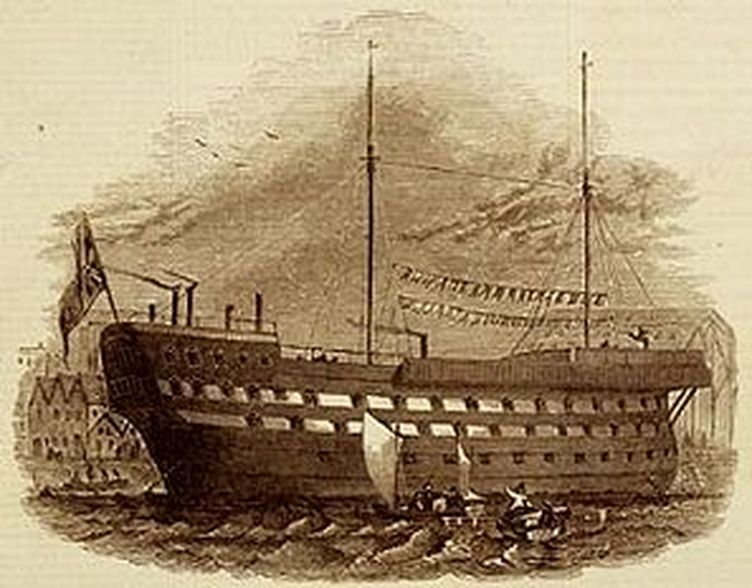
Prison Hulks

Transportation to America ended with the American War of Independence. This resulted in additional overcrowding of English prisons so a new solution needed to be put in place. In 1776 the Criminal Law Act (the Hulk Act) was passed allowing for prisoners to be housed in old ships, initially on the Thames at Woolwich. The convicts would be put to work to work on projects for the benefit of the navigation of the Thames.

Duncan Campbell was given permission to initially use two of his ships, the Justitia and the Censor to house the first prisoners. The Justitia, former convict ship, was the first ship used and when it was full the Censor also became a prison hulk. George Guest was transferred from Gloucester Gaol to the Censor to await transportation to Australia.

Initially there was little government supervision of the hulks.Campbell employed deputies and overseers to patrol the decks of the hulks and guard the prisoners. Food was scarce and of poor quality. This was a deliberate ploy as it was considered inappropriate that the prisoners appeared to be better treated than free people living in poverty. Conditions on the hulks were crowded and dirty. There was poor sanitation and diseases such as cholera, dysentery and typhus spread quickly. There was a high death rate on the hulks.

Image from Royal Museums Greenwich

The convicts on the hulks at Woolwich worked in chain gangs on projects relating to the Thames either in the dock yards or on the river banks. One of the tasks was to remove gravel and excess soil from the banks of the river.

The number of hulks increased and eventually were located at Deptford, Chatham, Gosport, Plymouth, Portsmouth, Sheerness and Cork as well as Woolwich. Duncan Campbell's contract to maintain his hulks was not renewed in 1802, but the hulk system continued until 1857. 

Fortunately George Guest remained on the hulk, Censor, only until February 1787 when he was transferred to the convict ship, Alexander, part of the First Fleet that arrived in New South Wales in January 1788.

Useful websites:

Duncan Campbell: the private contractor and the prison hulk - British Library Untold Lives blog

Convict hulks - Sydney Living Museum  

Convict hulks - The Digital Panopticon

Prison hulks - Royal Arsenal History

Prison hulks ( research guide) - National Library of Australia

Prisons & hulks (resources) - State Library of New South Wales

Thursday, 14 April 2022

The Old Gloucester Gaol

[Gloucester Castle keep: the old county gaol. Based on an 1819 work, from W. Andrew, ‘Old English Towns’, published 1909. Via Wikimedia Commons - Gloucester Crime History blog]

Brief history of the old gaol

The first gaol in Gloucester was in part of Gloucester Castle. The castle had been constructed early in the 12th century and part of it was in use as a gaol by 1185.

During the 17th century most of the castle was demolished but in 1672 the Sheriff of Gloucestershire insisted that the keep should be kept as the County Gaol.

By the late 18th century when George was a prisoner in the gaol, the building had become overcrowded and was in desperate need of repair. Some repairs were made between 1780 and 1782. The building was even fumigated in 1874.

In 1783 The Sheriff of Gloucestershire visited the gaol at the former castle keep and  recommended the building of a new gaol.

In 1784 an act was passed in parliament to make changes to the prison system including providing county magistrates the power to build their own prisons. William Blackburn drew up the plans for the new prison at Gloucester.

When plans for the new gaol were approved in 1785 the new building was to hold 207 prisoners.

In 1791 the first prisoners were transferred to the new building.

When George Guest (Gess) was an inmate of the prison between 1783 and 1786 the prison buildings were dilapidated and conditions for the prisoners were overcrowded, cramped, filthy, unhygienic and cold.  The prisoners had straw for beds which was rarely replaced. Food usually consisted of stale bread and pottage - a form of vegetable soup or stew which, on occasion, may contain small pieces of meat. 

There was one open sewer for the entire prison. Fleas, mites, lice and rats frequented the gaol. Disease was common in the gaol including typhus, also known as gaol fever. 

During the day the prisoners were usually put to work breaking rocks, picking oakum, beating flax or spinning yarn, making nails, mouse and rat traps, stools or garden tools. Groups of seven prisoners at a time could work the treadmill to grind corn and other cereals.

When considered necessary by gaolers, prisoners could be made to wear fetters and chains.

When the new prison opened in 1791 it was designed to hold 207 prisoners with separate sections for men and women. It also had exercise yards and a chapel. The prison was now under the jurisdiction of the Quarter Sessions.  Prisoners were now issued with prison clothes and even soap. The quality and quantity of food improved. Prisoners were also grouped according to their sentence rather than everyone being together. However by this time George Guest was in Australia.

Useful websites:

History of 1792 Old Gloucester Gaol - City and Country website

Gloucester Crime History - Prisons - blog (Jill Evans)

Conditions in Gloucester prisons - Gloucester Archives (article- pdf)


Tuesday, 29 March 2022

The Olympic Choir - Melbourne Olympic Games (part 1)

Recently I received an enquiry as to whether I had any additional information on the Olympic Choir that performed at the Olympic Games in Melbourne in 1956. Some years ago I gave a series of talks about my father's involvement as a sports journalist at the Olympic Games and at each talk people attending often provided additional information about involvement of their family members. At one of the talks I was given information about the Choir that sang at the Opening and Closing ceremonies.

The Official Report of the Organising Committee for the Games of the XVI Olympiad Melbourne 1956 provides come information about the Choir:

The Choir comprised members of the Royal Melbourne Philharmonic Society, City of Brighton Philharmonic Society, City of Camberwell Philharmonic Society, Royal Victorian Liedertafel, Myer Choral Society, Choral Association of Victoria and Melbourne University Choir, totalling 1,200 - sopranos, 600; altos, 200; tenors, 200, bases, 200. (page 226)

Opening Ceremony

The choir was placed in the main outer stand opposite the Royal Box and the rostrum. Immediately in front of the stand was a platform which accommodated the band of the Royal Australian Airforce under its Commanding Officer, Squadron Leader L H Hicks. The choir and band were conducted by Sir Bernard Heinze, Ormond Professor of Music, Melbourne University. The trumpeters of the Royal Australian Air Force band played also the Olympic fanfare for the raising of the Olympic flag. The fanfare was composed for the occasion by Squadron Leader Hicks. (page 226)

After the athletes from all the competing countries had entered the MCG during the Opening Ceremony, the Olympic Hymn was sung by the choir, accompanied by the band. The Dedication Address followed before the choir sang the Hallelujah Chorus. The flag bearers from competing countries formed a semi-circle around the rostrum where the oath was taken by John Landy. The National Anthem was played by the RAAF band and sung by the choir before the teams left the ground. (summary from pages 235-236) 

Closing Ceremony (pages 716 - 727)

An Australian Rules Football match was held on the MCG before the commencement of the Closing Ceremony. Before the football began the choir and the RAAF band were placed in the position they had occupied for the Opening Ceremony.

 During the Closing Ceremony the Olympic Hymn was sung by the choir while the Olympic flag was lowered. As the athletes left the ground the choir sang the Song of Farewell. Athletes from all nations inter-mingled, some of them walking rather than marching out of the vast Stadium to the lingering lilt of the old bush air and its cry of Good-bye Olympians followed by Will ye no' come back again?, taken up, still with emotional tremor in their voices, by the scores of thousands of spectators. 

Sir Bernard Heinze had suggested that the words of Waltzing Matilda should be adapted for the Song of Farewell (page 716).

Homeward, homeward, soon you will be going now;
Momok wonargo ora go-yai,
Joy of our meeting, pain of our parting,
Shine in our eyes as we bid you good-bye.

Good-bye, Olympians; good-bye Olympians,
(On comes the evening, west goes the day.)
Roll up your swags and pack them full of memories,
Fair be the wind as you speed on your way.

Blessings attend you, Fortune befriend you,
All good go with you over the sea.
May the song of our fathers - 'Will ye no' come back again?'
Sing in your hearts thro' the years yet to be.

Come to Australia, back to Australia,
(Mist on the hills and the sun breaking through)
With the sliprails down and the billy boiling merrily,
Wide open arms will be waiting for you.

A digital copy of The Official Report of the Organising Committee for the Games of the XVI Olympiad Melbourne 1956  is available online

 The Olympic Choir - Melbourne Olympic Games (part 2)

Olympic Games, Melbourne, 1956

The Olympic Choir - Melbourne Olympic Games (part 2)

In June 2013 Lloyd Jenkins wrote an account of his memories of his experiences of being in the Melbourne Olympic Choir in 1956. Lloyd gave me a copy of his notes in 2019. Below is a summary of Lloyd's experiences with the choir.

Twenty-four year old Lloyd Jenkins was one of the ten members of the Ballarat Choral Society selected to take part in the 1,200 member Melbourne Olympic Choir. Lloyd was one of the younger choir members. Choir members were expected to attend the four rehearsals held in Melbourne over several weeks before the Games began. Lloyd  travelled from Ballarat to Melbourne on a 1952 BSA 250 motor cycle.

The first rehearsal was at Wilson Hall, Melbourne University. The choristers sat in blocks - 600 sopranos, 200 contraltos, 200 tenors and 200 bass. On arrival they were told the pieces that would sing at the Opening and Closing ceremonies and eventually the appropriate sheet music was distributed. The choristers were also told that attendance at rehearsals was compulsory and a cardboard choir pass was issued with holes to be punched in it at each rehearsal. Squadron Leader Laurie Hicks was the rehearsal leader.  Eventually the choir would sing with the RAAF band but for this rehearsal they were accompanied by a pipe organ. At the first rehearsal the choir learned the Olympic Hymn.

Rehearsal number two was held at the Royal Exhibition Building where the choir members were seated on raked seating and were accompanied by an electronic organ. At this rehearsal the choir rehearsed the five items to be sung at the Olympic Games - God Save the Queen, the Halleluja Chorus, the Olympic Hymn, Waltzing Matilda (with new words) and Will Ye No Come Back Again?.

Back to the Exhibition Building on 9th November for rehearsal number three and this time the choir was able to practise with the RAAF band.To quote Lloyd, 'A choir of that size with a full sized Concert Band performing indoors makes an amazing sound.' For Lloyd, this rehearsal 'was the high point of the whole Olympic Choir experience... The sound within that building was unforgettable.'

On Sunday 18th November the fourth and final rehearsal was held at the MCG. This time 'Sir Bernard Heinze took the podium, a small platform there on the grass, facing the Band and the Choir.'  As Lloyd noted, 'the singers needed the experience of performing in that particular setting, mainly to build up confidence at pressing on against their own amplified sound from around the whole complex'. This rehearsal was not just for the band and the choir - 'the sound engineers and radio broadcast teams needed the experience as well'.

Thursday 22nd November 1956 was a warm sunny day in Melbourne - perfect for the Opening Ceremony. For Lloyd, 'perhaps the biggest moment was to see Australian Junior Mile Champion, Ron Clarke, enter the arena carrying the Olympic torch.' In summing up the day he concluded that the '110,000 spectators, and athletes, and the various officials and performers all had a day to remember forever.'

However it was the Closing Ceremony that created the greatest impression on Lloyd. 'If the Opening Ceremony was memorable, what about the amazing Closing Ceremony. The word amazing is not used lightly. Something happened at the Closing Ceremony that was not predicted. How could it have been predicted!. Neither could it have been orchestrated. It was spontaneous, a product of mass emotion.'

Traditionally at opening and closing ceremonies, teams entered and left the arena as separate nations however in Melbourne at the Closing Ceremony the athletes entered the stadium mixed together. They left in the same manner, walking, not marching. 'As the athletes left, the choir was singing its way through Waltzing Matilda and Will Ye No come Back Again?, two songs of farewell. 

We went straight from one into another, no break at all. Not all the athletes had left the Arena when the two songs were completed.' The conductor signalled for the songs to be repeated. As the words to the songs were printed in the  programme, 110,000 spectators gave full voice to their emotions as they sang with the Choir and the Band. 'A huge wave of emotion swept across the Stadium as the people sang and waved, and as the athletes marched and sang and waved.' 

'Magic moments like that take on a life of their own and any person who was there that day will understand what I am trying to describe' concluded Lloyd.

This account by Lloyd Jenkins of his experience of being a member of the Melbourne Olympic Choir at the Olympic Games in Melbourne in 1956 demonstates the ability of the power of music to add to the atmosphere of an event.

The Olympic Choir - Melbourne Olympic Games (part 2)

Olympic Games, Melbourne, 1956

Saturday, 11 April 2020

The First Fleet leaves Portsmouth

One of the projects during this period of social / physical isolation is to begin compiling information about the family history. Last term my seven year old grandson was asking questions about the convicts when he discovered that we have twelve convicts in our family including two who came on the First Fleet.
Today I decided to revisit the database, British Library Newspapers, which can be accessed from the website of the State Library of Victoria by those with a library card. Other major libraries will probably provide a similar service. The database provides access to digitised copies of articles published in Britain from the 1700s.

I used the advanced search option allowing me to search for a variety of terms such as "Botany Bay" and "Portsmouth" or "Botany Bay" and "Convicts" or just "Botany Bay" and restricting the time period of the search using the dates between option. I experimented  with a number of options.


Clicking the images below will provide a larger image.

On the surface the departure of the First Fleet for Botany Bay did not create much interest in the local press but aspects of the story can be discovered by exploring references to the departure of the ships during 1787.
 

The First Fleet left the Motherbank, Portsmouth, on 13 May 1787. From the beginning of the year convicts had left the gaols in which they had been imprisoned and loaded into wagons for the journey to Portsmouth. The Chelmsford Chronicle March 2 1787 carries a short report from the House of Commons, 26 February 1787.

 
On 7 May 1787 the Hampshire Chronicle added the following information about new convict arrivals aboard ships.
The following information about the ships at Portsmouth was provided on March 19 1787 in the Hampshire Chronicle. The paragraph in Home News listed the names of the ships that would be sailing to Botany Bay and also noted the captains of each ship and number of convicts and others on the vessels.

The Norfolk Chronicle reported on May 12 1787 that the fleet was ready to sail the next day.


A report dated 13 May appeared in the Northampton Mercury May 19 1787 that the ships had sailed that morning. The frigate, Hyaena, was to accompany them for the first part of the journey.
 The Hereford Journal May 17 1787 announced that the ships had sailed for Botany Bay.
A report on the initial progress of the fleet appeared in the Norfolk Chronicle May 26 1787 providing a quote forom a letter from Plymouth dated May 16.
Another short report in the Leeds Intelligencer May 22 1787 provided the coordinates of the ships when last sighted.
Over the ensuing months the newspapers provided information about the progress of the fleet either when a ship arriving in England reported a sighting of the ships or carried letters from First Fleet ships' officers.

The Hyaena brought a letter from an officer of the Friendship dated 20 May. A summary appeared in the Northampton Mercury 9 June 1787.

  Another report appeared in the Northampton Mercury June 30 1787.
The Hampshire Chronicle 30 July 1787 published part of a letter dated June 5 from Teneriffe written by an officer.
The ships of the First Fleet arrived in Rio de Janeiro in August to restock the food supply. This information appeared in the Stamford Mercury November 30 1787.

These snippets of information provide useful information on the commencement of the First Fleet voyage.

Saturday, 11 January 2020

2019 in review

2019 was a quieter year for family history research and resulted in only nineteen posts in my blog however quite some time was spent doing background reading and online courses on Future Learn which should help when writing family stories.

My Resolutions blog post at the end of 2018 listed a number of aims for the year - some of which I completed, some I started and some will have to go on the To Do List for 2020.

In 2018 I undertook the #52Ancestors in 52 Weeks challenge but left undone topics for eight weeks in the middle of the year as we were overseas. I did write those posts in 2019 so that is one tick.

I also wrote that I was going to concentrate on organising my collection starting with purchasing new storage boxes from Archival Survival. Ten boxes have been assembled and await my attention near my desk. This is a definite project for the new year combined with plans for reorganising the computer room now that the cot that has been in the room for nine years is no longer required for grandchildren. There will also be more space when boxes of toys are stored in another room. The plan is to have new shelves to hold my boxes, books relating to my family history plus folders. Having the material in one place should make finding material more efficient, especially as this would be the perfect excuse to sort items properly.

One aim was to write posts about musicians in the family and I wrote a two on that topic (although one was published on New Year's Eve 2018). I also wrote several posts on sport - one on the Stawell Gift which my father attended annually. Towards the end of the year, on two occasions, I repeated a talk that I first made three years previously about my father's involvement reporting on the Melbourne Olympic Games. Discussion at these talks resulted in the compilation of two more posts on this topic.

A number of history based television shows during the year provided background material on ancestors who lived many centuries ago. The SBS series, The Rise of the Clans, hosted by Neil Oliver had two episodes on Robert the Bruce and his family.  The End of Empire: the Rise and Fall of Dynasties on the History Channel was about the Saxon king, Edgar, who is credited with being the first King of All England. Another episode in this series was about Charlemagne - a topic for another occasion. The Family Legend prompt in the #52Ancestors challenge allowed for a post on  the branch of the family tree with the royal connections.


Events relating to 50 year anniversaries in our lifetime formed two more posts plus a post on significant trees in family gardens.

I have also read a number of books during the year, many of them relating to events in my family history.


In 2019 I took out an unlimited subscription to Future Learn online courses for a year and had a wonderful time exploring courses primarily relating to history and archaeology but also literature, health and even science. I also spent some time exploring the Italian language as two of my grandchildren learn Italian at school.

The University of Strathclyde ran three excellent online courses towards the end of the year 
Working lives in the Factories and Mills: Textile History and Heritage
Working Lives in the Coalmines: Mining History and Heritage
Working Lives on Britain's Railways: Railway History and Heritage. 
(With family who worked in the textile industry and in the railways, these will be very useful).

Lancaster University 
Lancaster Castle and Northern English history - more family connections. 
Humphry Davy (invention of the miners' lamp and other scientific discoveries).

University of Glasgow 
The Scottish Highland Clans: Origins, Decline and Transformation. This course complemented The Rise of the Clans television series. 
Early Modern Scottish Paleography
The History of Royal Fashion (the last 500 years).

University of Edinburgh 
Bonnie Prince Charlie and the Jacobites
How to Read a Novel (a look at modern fiction)

British Film Institute 
The Living Picture Craze: an Introduction to Victorian Film

University of Aberdeen 
Walter Scott: the Man behind the Monument

Royal Holloway, University of London 
Beyond the Ballot (the campaign for women's right to vote in Britain).
Peterloo to the Pankhursts: Radicalism and Reform in the Nineteenth Century.

Trinity College, Dublin 
The History of the Book in the Early Modern period: 1450 to 1800. 
The Book of Kells.

University of Groningen 
The Scientific Revolution (how seventeenth century science shaped the modern world)

University of Exeter 
Empire (debate about the British Empire)

University of Newcastle (Australia)
 Great Southern Land: Introducing Australian History

National Maritime Museum 
Confronting Captain Cook - Memorialisation in Museums and Public Spaces

University of Reading 
Rome (exploring the ancient city using 3D models)
Archaeology (this was one of the first courses that I did some years ago)

Durham University 
Archaeology and the Battle of Dunbar 1650: From the Scottish Battlefield to the New World.  
Forensic Archaeology and Anthropology.

Griffith University 
Written in Bone: an Introduction to Forensic and Bioarchaeology. 
A Question of Time (what dating fossils can tell about evolution).
Music Psychology: Why does Bohemian Rhapsody feel so good?

Monash University - Food as Medicine

Other Future Learn history related courses that I have done in other years include:
Lancaster University
Radical Spirituality (new seventeenth century religions including Quakers)

University of Southampton
Agincourt 1415

Newcastle University (UK)
Hadrian's Wall: Life on the Roman Frontier

University of Leicester
England in the Time of King Richard III

Monash University
World War I: A History in 100 Stories

UNSW Canberra
World War 1: Lessons and Legacy of the Great War

Trinity College, Dublin
Irish Lives in War and Revolution

Future Learn has courses on many topics so it is well worth exploring to see if there is anything of interest. If you just want to do a course and don't want access to the material after the conclusion of the course, there is no charge. This year I decided to pay the annual fee for additional access to the material, allowing me to refer to some of the topics as required.

Last year I was asked why I didn't join U3A. My reply was that I didn't need to as I have Future Learn

It has been an interesting year exploring a wide variety of topics, however this year my resolution is to concentrate on writing at least part of the family story for my family.

Saturday, 16 November 2019

Melbourne Olympic Games - 1956

I recently gave two more talks about the Melbourne Olympic Games where I have met many people with memories and family involvement with the games.

When I showed a slide of a picture of the Opening Ceremony on the cover of the Australian Women's Weekly a gentleman at one talk asked me to stop at the picture and pointed out two white squares in the picture. The two white squares are the Melbourne Olympic Choir.

He was a member of a combined community choir - the Melbourne Olympic Choir - that sang at the 1956 Melbourne Olympic Games. Lloyd gave me notes that he had written about his experiences with the choir which consisted members of community choirs throughout Victoria. As well as singing at the Opening Ceremony the choir performed at a number of events including the Closing Ceremony.

Other people at the meeting were Betty who, as a member of the St John's Ambulance Brigade, attended many of the events working with that organisation.
Museum of Applied Arts and Sciences
Presentation books showing pictures of Melbourne and surrounding areas were presented to members of the Olympic Committee who would eventually vote for the city to host the 1956 Olympic Games. Three special invitation books with lambs’ wool covers decorated with jewels were presented to three people including the King of England and the President of the OIC. Other copies were also covered with lambs’ wool and decorated with an enamelled emblem. Copies were also covered with suede plus enamelled emblems. The books were presented to member of the International Olympic Committee in 1948 and also to local supporters of the project. The company that printed the books was Spicers & Detmold in Coburg and one of the ladies present at the meeting was a daughter of one of the printers who made the books.
A copy of the book with the invitation
The Melbourne Invitation Committee extends a most cordial invitation to the esteemed International Olympic Committee to celebrate the XVI Olympiad in Melbourne, Australia, in 1956. 
A second book, published as a supplement to the first book, was published in January 1949 and was posted to all delegates of the Olympic Committee who would decide who would host the Games in 1956.
 
Another lady told us that her mother helped make the presentation cushions used for medal presentations at the Melbourne Olympic Games.
 
Official Report of the Organising Committee for the Games of the XVI Olympiad Melbourne 1956

When we were discussing who attended any events at the Olympic Games one couple laughed and the husband said that he went to the Closing Ceremony because the soccer final was played before the ceremony and he is a soccer fan. Meanwhile his wife stayed home and looked after the baby.
Program for the Closing Ceremony
Another connection to the Melbourne Olympic Games was one lady who said that she trained in athletics with Betty Cuthbert. At the Melbourne Olympic Games Betty Cuthbert won the 100m and 200m and was in the Australian 4 x 100m relay team which also won gold.
Marlene Matthews with Betty Cuthbert
The water polo incident in the Hungary and Russia  match was also mentioned in the game. The book by Harry Blutstein, Cold War Games, covers this unfortunate incident. This incident was later referred to as 'blood in the water'.
Blood in the Water
At the second talk the father of one lady was involved in the printing of the tickets for the Melbourne Olympic Games.


The three talks that I have given have provided additional information about the Melbourne Olympic Games.