Saturday, 1 April 2023

Medieval Queens in the Family Tree - Philippa of Hainault

Philippa of Hainault (1314-1369)

Philippa of Hainault married King Edward III. 

The actual date of the birth of Philippa of Hainault is uncertain but it is thought she was possibly born in February 1314. Her father was Willem, Count of Hainault (in modern-day Belgium), Holland, and Zeeland in the Netherlands. Her mother was Jeanne de Valois, the sister of King Philip VI, who ruled France from 1328–1589. 

When she was twelve Philippa was promised in marriage to the future Edward III of England. This was an arrangement between Philippa's father and Edward's mother, Queen Isabella of England. Isabella required both soldiers, ships and money to fund her campaign to defeat her husband, King Edward II, and remove him from power. The marriage between  Philippa and Edward was arranged as part of the exchange for the Count of Hainault assisting Isabella.

Philippa arrived in England in 1327, 11 months after the forced abdication of Edward II. On 25 January 1328, she married Edward III in York. He was fifteen and she was almost fourteen. After Edward took control of the country from his mother in 1330, Phillipa was crowned Queen and was granted land and her own income.

Edward and Philippa had thirteen children. Nine survived childhood - Edward (the Black Prince), Isabella, Joan, Lionel (1st Duke of Clarence), John (1st Duke of Lancaster), Edmund (1st Duke of York), Mary, Margaret and Thomas (1st Duke of Gloucester).

Philippa worked tirelessly for the country, maintaining balance between royal duties and family duties. However she loved clothes and jewells and spent extravagent sums of money on these items. Nevertheless she was widely loved and respected as a queen by her English subjects

As the financial demands of the Hundred Years' War were enormous, Philippa advised the King to take an interest in the nation's commercial expansion as a method for recovering expenses. She established the textile industry in Norwich by encouraging Flemish weavers to settle there and promoted coal mining in Tynedale.

Philippa accompanied Edward on expeditions to Scotland and part of Europe in the early campaigns of the Hundred Years War, where she won acclaim for her gentle nature and compassion

In 1346 Philippa served as regent of England when her husband was overseas. During this time there was a Scottish invasion and Philippa gathered the English army to fight the Scots at the Battle of Neville's Cross near Durham. Before the battle, on horseback, she rallied the English soldiers. The  English victory resulted in the Scottish King David II being taken prisoner.

On 15 August 1369, Queen Philippa died at Windsor Castle. She was given a state funeral six months later on 9 January 1370 and was interred at Westminster Abbey. Eight years later, Edward III died and was buried next to Philippa. It would appear that their forty-year marriage had been happy.

Tomb of Edward and Philippa

Friday, 31 March 2023

Medieval Queens in the Family Tree - Isabella of France

Isabella of France (1295-1358)

Isabella of France married King Edward II

Isabella was born in Paris, probaby in 1295. Her parents were King Philip IV of France and Queen Joan I of Navarre and her brothers Louis, Philip and Charles became kings of France. Isabella was brought up in and around the Louvre Palace and the Palais de la Cité in Paris. She received a good education and developed a love of books. 

All of Philip's children were married young for political benefit to France. When she was ten years old Isabella was promised in marriage by her father to Edward, the son of King Edward I of England, in the hope of resolving the conflicts between France and England over England's possession of Gascony and claims to Anjou, Normandy and Aquitaine. Isabella and Edward II were married at Boulogne-sur-Mer on 25 January 1308 when Isabella was twelve and Henry II was twenty-three.

Isabella was considered to be very beautiful. She came from a wealthy family and loved beautiful objects. This included elaborate clothes and her wardrobe around the time of her marriage included dresses of silk, velvet, taffeta and other cloth, along with numerous furs. She had more than 72 head-dresses and coifs and she took to England two gold crowns, gold and silver dinnerware and 419 yards of linen.

Edward II had become King of England on 7 July 1307 when his father, Edward I, died. The coronation of Edward and Isabella was held at Westminster Abbey on 25 February 1308.

Isabella and Edward II had four children - the future Edward III, was born in 1312,  John in 1316, Eleanor in 1318 and Joan in 1321.

The relationship between Isabella and Edward II was not a close one. Isabella faced numerous challenges during their marriage. 

Edward was a handsome man, but he was unconventional as he appeared to form close romantic attachments to men: first to Piers Gaveston and then to Hugh Despenser the Younger. On the political front Edward often disagreed with the barons, in particular his first cousin Thomas, 2nd Earl of Lancaster. He also continued the war against the Scots that he had inherited from Edward I. 

Using her own supporters at court and the patronage of her French family, Isabella attempted to find a political path through these challenges. She successfully formed an alliance with Gaveston, but after his death at the hands of the barons, her position grew increasingly precarious. Edward then began to take revenge on his enemies, forming a strong alliance with the Despenser family, in particular his new favourite, Hugh Despenser the Younger. 

When Isabella had accompanied the English troops in a battle against Scottish forces in 1322, Isabella and her supporters were separated from the main army and had to escape by ship. During this time Edward cut Isabella's allowances and, from 1324, when tensions with France increased, her lands were confiscated and she was denied access to her younger children. Unsurprisingly this resulted in further animosity between Isabella and Edward. By 1326 Isabella finally made her own bid for power including an invasion of England. 

In 1325 Isabella had returned to France to negotiate a peace treaty with the French king. However many of the nobles opposed Edward's reign and Isabella was able to form an army to challenge Edward, in alliance with Roger Mortimer, 1st Earl of March. Isabella and Mortimer may have been in a relationship by this time.

Isabella and Mortimer returned to England with a mercenary army and gained control of the country in a lightning campaign. Members of the Despenser family were executed and King Edward II was forced to abdicate in favour of his son, King Edward III.  Edward II was initially imprisoned in a castle overseen by the Duke of Lancaster. Isabella strengthened her control, particularly in London, by taking over the Tower of London. A council of nobles and church leaders in January 1327 decreed that Edward II should remain in prison for the rest of his life. 

Due to fear that those opposed to the new government might make plans to free Edward II it was decided to move him to the more secure location of Berkeley Castle in Gloucestershire from approximately 5 April 1327.  How well he was cared for is in dispute. As a result of threats to rescue the former king, Edward was moved to other locations in secret before returning to permanent custody at the castle in late summer 1327. The political situation remained unstable. New plots appear to have been planned to free him. On 23 September Edward III was informed that his father had died at Berkeley Castle during the night of 21 September 1327. There are many stories about how Edward II might have died. There are even stories that he escaped. However the accepted story is that Edward II's body was buried at Gloucester Cathedral. Isabella continued to rule as regent until 1330, when her son, Edward III ruled in his own right.

During the four years when Isabella and Mortimer were regents, Isabella acquired huge sums of money and land. In 1330 Edward III deposed Mortimer in a coup, taking royal authority for himself. However Isabella survived the transition of power and remained a wealthy and influential member of the English court, though she was not directly involved in active politics.

For some time Isabella was transferred to Berkhamsted Castle,and then held under house arrest at Windsor Castle until 1332, when she then moved back to her own Castle Rising in Norfolk. After losing power in 1331, Isabella remained extremely wealthy despite having to surrender most of her lands.  She was reassigned an annual income of £3000, which increased to £4000 by 1337. 

Isabella lived an expensive lifestyle in Norfolk, including minstrels, huntsmen, grooms and other luxuries, and was soon travelling around England again. In 1348, there were plans for her to visit Paris in order to take part in peace negotiations, but this plan did not eventuate. However she was involved in the talks with Charles II of Navarre in 1358. Isabella became a nun at the Order of St Clare before she died on 22 August 1358 at Hertford Castle. Her body was taken to London for burial at the Franciscan church at Newgate.  

In her final years Isabella became closer to members of her immediate family. When she died Isabella left most of her property, including Castle Rising, to her favourite grandson, the Black Prince, with some personal effects being granted to her daughter Joan.

In later life, Isabella remained interested in Arthurian legends and jewellery and she continued to wear lavish costumes when making public appearances. For example, in 1358 she appeared at the St George's Day celebrations at Windsor wearing a dress made of silk, silver, 300 rubies, 1800 pearls and a circlet of gold.

Isabella was Queen of England for eighteen years, then served four years as Regent. She was a complex queen who was not afraid to use her power when she thought that change, such as removing her husband from the throne, was required. However Isabella was not univerially liked by her English subjects, especially when she became involved with Roger Mortimer. After her son, Edward III, was king she remained in the background of royal life for another twenty-eight years.

Monday, 27 March 2023

Medieval Queens in the Family Tree - Eleanor of Castile

Eleanor of Castile (1241-1290)

Eleanor of Castile married King Edward I

Eleanor was born in 1241, the daughter of Ferdinand III of Castile and Joan, Countess of Ponthieu. Her Castilian name, Leonor, became Alienor or Alianor (later Eleanor) in England. 

In November 1254 Eleanor married King Henry III's son, Edward, in Burgos in Spain. She would have been 13 and Edward was 15. This was a marriage arranged by their parents to ensure political security of Gascony in southern France claimed by the English. However over the years their marriage developed into a close relationship.

Eleanor and Edward had sixteen children but only six grew to be adults including a son who became King Edward II.

Edward spent much time travelling around his kingdom and Eleanor normally accompanied him. She also went with Edward when in 1270 he travelled to Acre in Palestine for the Eighth Crusade. 

On 16 November 1272 King Henry III died.Edward and Eleanor were in Sicily when they received news of the King's death some months later. Edward had been wounded during the crusade and although the actual wound was not serious he developed health problems slowing down their journey back to England. When in Gascony Edward had to suppress another uprising. A son, Alfonso, was also born in Gascony.

Therefore it was two years into his reign when Edward and Eleanor returned to England on 18 August 1274. On 19 August Edward and Eleanor were crowned King and Queen of England at Westminster Abbey.

Eleanor was not actively involved in public life to the extent that Eleanor of Provence had been but she no doubt influenced some of the King's decisions in private. Eleanor was well educated and exerted a strong cultural influence on England. She was a keen patron of literature and introduced the use of tapestries, carpets and tableware in the Spanish style. Eleanor also had innovative garden designs created. She was a successful businesswoman, endowed with her own fortune as Countess of Ponthieu, but she also acquired many English properties, making her unpopular with some of the population. 

On 28 November 1290 Eleanor died while she and Edward were on one of their journeys around England. Eleanor died at Harby in Nottinghamshire, near Lincoln. She was 49 years old and had been married to Edward for 36 years. She had been queen for sixteen years. Eleanor's body was buried at Westminster Abbey.

Edward later ordered that a series of memorial crosses should be erected at each overnight stop the procession carrying Eleanor's body back to London made. Twelve monuments known as Eleanor Crosses were erected. Three remain almost intact today including the Northampton Eleanor Cross at Geddington.

Eleanor Cross, Geddington

Wednesday, 22 March 2023

Medieval Queens in the Family Tree - Eleanor of Provence

Eleanor of Provence (1223-1291)

 
Eleanor of Provence was the wife of King Henry III.

Born in the city of Aix-en-Provence in southern France, Eleanor (or Alienor) was the second daughter of Ramon Berenguer IV, Count of Provence (1198–1245) and Beatrice of Savoy (1198–1267). After her elder sister Margaret married Louis IX of France, their uncle William of Savoy persuaded Henry III of England to marry Eleanor. 

Eleanor and Henry were married at Canterbury Cathedral on 14 January 1236. This was the first time that Eleanor had met Henry. They then travelled to London where Eleanor was crowned Queen Consort at Westminster Abbey.

Eleanor and Henry had five children - Edward I of England, Margaret who married Alexander III of Scotland, Beatrice, Edmund and Katherine. 

In 1253 Eleanor was regent of England when Henry III when Henry was in France. On a number of other occasions she travelled back to France with him.

During Henry's reign, Eleanor remained loyal to her husband but she was not popular with many of the English people as Eleanor had brought people from Provence to England to serve her, some being given positions of power in England. In 1263 there was a dispute in London when Eleanor demanded the back payment of queen gold - a ten percent tax on fines in London which was to be paid to the queen. She had to be rescued by the Mayor of London.

When King Henry died in 1272, Henry and Eleanor's eldest son became King Edward I. Eleanor remained in England as Queen Dowager and raised several of her grandchildren.

In 1286 Eleanor retired to Amesbury Priory in Wiltshire, eight miles north of Salisbury. Two of her granddaughters – Mary of Woodstock and Eleanor of Brittany – were already nuns there, each having entered the priory when they were seven years old. Eleanor died at the priory in June 1291 and was buried there.

Eleanor was known for her learning, cleverness, and skill at writing poetry, as well as her beauty. She loved the songs of the troubadours. She enjoyed reading  romantic and historical books that included stories from ancient times to thirteenth century contemporary romances.

Eleanor was also known as a leader of fashion, especially clothes imported from France. Her favourite clothes were made from red silk damask and she often wore parti-coloured  tunics, gold or silver girdles and gilt decorations on her clothes. She favoured jaunty pillbox caps worn with a wimple. 

Saturday, 4 March 2023

Medieval Queens in the Family Tree - Isabella of Angoulême

Isabella of Angoulême (c1186 -1246)

 
Isabella was the wife of King John.
 
On 8 October 1200, Isabella of Angoulême was crowned Queen of England at Westminster Abbey. On 8 August 1200 Isabella had married King John of England in Angoulême. Isabella was born around 1188 making her twelve years old (or fourteen if another possible date for her birth is correct). Isabella was the only daughter and heir of Aymer Taillefer, Count of Angoulême, and Alice of Courtenay. Alice was a grandchild of King Louis VI of France. Isabella became Countess of Angoulême in her own right on 16 June 1202.

King John had previously been married to Isabella, Countess of Gloucester. The marriage was annulled in 1199. At the time of the marriage Isabella was already engaged to Hugh IX le Brun of Lusignan. 

John took Isabella back to England in October, after a tour of Normandy, where she accompanied him on many of his travels around the country. However Isabella never engaged in positions of power in England in her own right.  John continued, from time to time, to follow the advice of his mother, Eleanor of Aquitaine until her death in 1204.

Before the marriage there had been unrest in a number of French provences, especially between the English and the French who both wanted power in the region. During the remainder of King John's reign the unrest magnified. In 1206 John and Isabella returned to France as John attempted to strengthen contol of Poitou. Angoulême and Aquitaine remained loyal to England at that stage.

Another threat to John's power was that his nephew, Arthur, also claimed the English throne and Arthur's claim was generally supported by the French. Consequently there were many battles over part of territory claimed by England in France. Back in England John's popularilty decreased as land claimed by England in France was reclaimed by the French.

Isabella was renowned for her beauty. She was also said to have a temper which she was not afraid to use.

During her marriage to King John, Isabella and John had five children - Henry (later King Henry III), Richard, Joan, Isabella and Eleanor.

After John died in 1216, Isabella returned to France and in 1220 married Hugh X of Lusignan and they had nine children.

Isabella died on 6 June 1246 and was buried at Fontevraud Abbey.

Wednesday, 1 March 2023

Medieval Queens in the Family Tree - Eleanor of Aquitaine

 Eleanor of Aquitaine (1122-1204)

 
Eleanor of Aquitaine was initially the wife of Louis VII of France. She later married King Henry II of England.

Eleanor of Aquitaine was probably born around 1122 - no definite information has been found. Her father was William X, Duke of Aquitaine, the area south of Normandy and the largest province in France. Her mother was Aénor de Châtellerault.

Eleanor's mother and brother died in 1130. Her father ensured that she had the best possible education including  learning arithmetic, the constellations, and history as well as domestic skills such as household management plus embroidery, needlepoint, sewing, spinning, and weaving.  Eleanor also developed skills in conversation, dancing, games such as backgammon, checkers, and chess, playing the harp, singing and literature. Eleanor was also taught to read and speak Latin and was taught the skills of riding, hawking, and hunting. Not surprisingly, Eleanor was said to be extroverted, lively, intelligent, and strong-willed.

When Eleanor's father died in April 1137, Eleanor became Duchess of Aquitaine. Louis VI became her guardian and three months later married the the young girl to his son. This meant that Aquitaine came under control of the French King. Later that year the French king died and his son became King Louis VII while Eleanor became Queen of France. Eleanor and Louis VII had two daughters during their marriage.

Crusades

The Crusades were a series of wars between Christians and Muslims to gain control of religious sites considered important to both groups. Between the years 1096 and 1291 there were eight crusade expeditions. European leaders often felt it was their duty to become involved in a crusade.

On Christmas Day 1145, Louis VII announced his intention to go on a crusade to the Middle East. Eleanor of Aquitaine announced that she would go too with soldiers under her command from the duchy of Aquitaine. They left in June 1147. Louis VII proved to be an ineffectual military leader with little discipline over his troops. Eleanor and Louis spent three weeks in Constantinople where Eleanor was compared with a mythical Queen of the Amazons. As a military exercise the French involvement in the Second Crusade was not particularly successful. The French army was divided and although they reached the outskirts of Jerusalem and then went on to Damascus, little was to be achieved. The French army was disheartened and Louis returned to Jerusalem and back to France via Rome.

While on crusade, Eleanor observed and learned about maritime conventions that later became admiralty law. She introduced these conventions on islands in Aquitaine and later in England when she became Queen of that country.

Anulment of the marriage

Before they left for the Crusade the relationship between Eleanor and Louis was fractured and the relationship worsened in the years they were absent from France. On the return journey they travelled in different ships which became separated during a storm and it was several months before they met again.

Back in France in 1152 Louis agreed that the marriage should be annulled as he needed a male heir and he and Eleanor had only produced two daughters. On 21 March 1152 four bishops met and agreed to anul the marriage as it was decided that Louis and Eleanor should not have married as they were distant cousins with a common ancestor in Robert II of France. King Louis kept custody of his daughters while Eleanor was once again sole ruler of Aquitaine. Eleanor had been Queen of France for 15 years. She was now probably 30 years old.

Marriage to Henry II

On 18 May 1852 Eleanor of Aquitaine married Henry, the son of Empress Matilda and Geoffrey of Anjou. Henry was eleven years younger than his wife. It was definitely a marriage of convenience as Eleanor needed a husband and Henry needed a wife to produce male heirs. Those arranging the marriage ignored the fact that Eleanor and Henry also shared common ancestors.

Eleanor and Henry had eight children - William, Henry, Matilda, Richard, Geoffrey, Leonora, Joan and John.   Henry also had other children outside the marriage.

On 25 October 1854 Henry was crowned Henry II of England. Eleanor was crowned Queen of England on 19 December 1154.

Henry hoped to take over Aquitaine but the nobles there supported only his wife as ruler of the duchy. Meanwhile the relationship between Henry and his wife deteriorated and in 1167 Eleanor decided to return to Aquitaine via Argentan in Normandy. Henry escorted her for part of the journey so did not appear to be worried about her departure. Eleanor remained in Poitiers, Aquitaine, from 1168 to 1173. While in Poitiers Eleanor is said to have refined the behaviour of palace life with the introduction of troubadors, chivalry and courtly love.

Between 1173 and 1174 Henry and Eleanor's son, Henry, staged a revolt against his father and Richard and Geofrey, two of his younger brothers who had been living with their mother, were encouraged to join him. Eleanor did not discourage her sons in this venture and probably asisted them.

Around April 1174, Eleanor was arrested by Henry's soldiers and taken to her husband who was at Rouen. On 8 July they left France on a ship to England where Eleanor was imprisoned in various castles throughout the country for the next 16 years. She was allowed out for special occasions such as Christmas.

In 1183 King Henry's son, Henry, led a revolt against his father in Normanby but was unsuccessful. In June 1183 the young Henry caught dysentry. Before he died he begged his father to release his mother from imprisonment. After the death of the prince there was a dispute about Normandy which King Henry decided belonged to his wife. Eleanor was allowed supervised release to spend time in Normandy.

After returning to England in ealry 1184 Eleanor often accompanied her husband when he travelled around England and sometimes assisted him with government business. However she remained closely supervised making it clear to her that she was not free.

After the death of Henry II

Then on 6 July 1189 Henry II died. Eleanor's son Richard became King Richard I. Richard ordered that his mother should be released from imprisonment and Eleanor initially ruled England in the name of her son. On 13 August 1189 Richard I left France to visit England. 

Richard I was absent from England between 1190 and 1194, with the Third Crusade followed by two years as a prisoner until a huge ransom could be paid to Henry VI, Emperor of Germany. The money for the release of King Richard was raised from English funds.

During King Richard's absence, a Council of Regency with a Chief Justciar ruled England though Eleanor worked behind the scenes to raise the ranson money. She still exercised much influence over the affairs of England. She also wrote numerous letters to the Pope about Richard's imprisonment. King Richard returned to France where he died on 6 April 1199.

When her yougest son, John, became King of England, Eleanor remained in the background of royal politics including travelling to France to select from family members a future wife for the son of Philip II of France. This proved to be a dangerous journey for Eleanor who faced ambush  and spent a short time in captivity until a ransom was paid.  In 1201 Eleanor supported King John when war broke out between England and the French.

Eleanor returned to Fontevraud to join the abbey as a nun. She died at Fontevraud Abbey 1 April 1204 and was buried in the abbey next to her husband (King Henry II) and her son (KIng Richard I). Eleanor was probably 82 when she died.
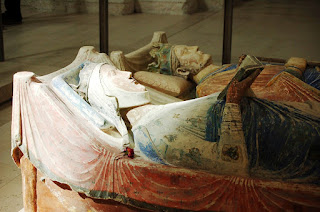
Tomb effigies of Eleanor and Henry II at Fontevraud Abbey
  Tomb effigies of Eleanor and Henry II at Fontevraud Abbey  

On Friday15 March 2024, SBS broadcast the BBC program The Rebel Queen - Eleanor of Aquitaine which was part of the series Queens that Changed the World.

Saturday, 25 February 2023

Medieval Queens in the Family Tree - Matilda of Scotland

 Matilda of Scotland (1080-1118)

Matilda of Scotland married King Henry I.

Matilda, christened with the Anglo Saxon name of Edith, was born in Dunfermline in Scotland in 1080. She was the daughter of King Malcolm III of Scotland and Margaret (after her death Saint Margaret) of Scotland. Edith's godfather was Robert Curthose, son of King William I of England, while her godmother was Matilda of Flanders, King William's wife. 

Edith's mother was related to former Anglo Saxon kings. Margaret's brother, Edgar, would have been the successor to King Harold who was killed at the Battle of Hastings. However when William the Conqueror won the battle, Edgar's family, including Margaret, sought refuge in Scotland.

Matilda (Edith) had six brothers and one sister.

Edith and her sister Mary were sent to England to Romsey Abbey in Hampshire where their aunt was the abbess. Edith was about six years old. The girls also spent time at Wilton Abbey in Wiltshire. Subjects included English, French and some Latin. Edith left Wilton Abbey in 1093.

At Westminster Abbey on 11 November, 1100, Edith married King Henry I who was 32 and needed a wife. Henry chose Edith because of her strong connections with the former Anglo Saxon royalty which he hoped would encourage the acceptance of the Normans in England. The Archbishop of Canterbury objected to the marriage as he argued that as Edith had been educated in an abbey she must have taken holy orders. Eventually he was convinced that this was not the case and the marrige went ahead.

After the wedding Edith was crowned Queen Matilda using the name of Henry's mother. She is normally referred to as Matilda of Scotland.

Although Matilda and Henry had four children only two survived to adulthood. Then in November 1120, their son, William, drowned when the White Ship sank in the English Channel during a storm. This left their daughter, Matilda, as Henry's legitimate heir although he is said to have fathered around 25 children with other women. 

As queen, Matilda travelled with her husband throughout England and Normandy. Her many years living in abbeys no doubt influenced Matilda's life as she was always generous to the poor. Matilda had a leper hospital built in London. She also founded the Holy Trinity Priory at Aldgate. Matilda commissioned a biography about her mother to be written - The Life of St Margaret.

Matilda died on 1 May 1118 when she was 38. It is not known for certain where she was buried.

After Matilda of Scotland's death, Henry married again in the hope of fathering a legitimate son. When this did not happen he made his nobles swear that they would support his daughter, the Empress Matilda, as the next monarch. All did not go as planned, but that is another story.

When we visited Edinburgh Castle in 2014 we took time to visit St Margaret's Chapel which King David had built in the castle grounds in honour of his and Matilda of Scotland's mother.

Medieval Queens in the family tree - Matilda of Flanders

Matilda of Flanders (1031-1083)

Impression of what Matilda might have looked like

Matilda of Flanders married King William the Conqueror.

Matilda was born in Flanders, France, in 1031. She was the daughter of Count Baldwin V of Flanders and Adela, daughter of King Robert II of France. Possibly in 1052 or 1053 Matilda married William, Duke of Normandy, - an alliance to secure the relationship between Flanders and Normandy. The Pope did not approve of the marriage initially but the wedding took place anyway and some years later a papal blessing on the marriage was given.

Matilda and William had four sons, including the future Henry I of England, and five daughters.

In Normandy Matilda worked with William managing the region including preciding over the courts and witnessing charters. She often travelled with her husband when he was visiting parts of his duchy. When William travelled to England for the Battle of Hastings, Matilda was left in charge.

Duke William of Normandy and Edward the Confessor, King of England, were related and William believed that as the English king had no children he was heir to the English throne. However, before his death, the English king selected Harold Godwinson, a military leader, as his successor. William and his army then headed to England to fight Harold for the right to rule England. King Harold II won a victory against an attempted Viking invasion shortly before facing William at the Battle of Hastings which William won on 14 October, 1066. 

William, Duke of Normanby, was crowned William 1 of England in Westminster Abbey on Christmas Day 1066. Matilda was crowned as Queen of England in 1067.

During the following years, much of William's time was spent securing his position as King of England. At times Matilda joined him in England but much of her time was acting as his regent in Normandy until their eldest son, Robert Curthose, was old enough to be more involved. Unfortunately William and Robert did not get along for much of the time resulting in much antagonism between the two men. For a while Matilda supported her eldest son providing him with money to support his campaign against his father. The matter was eventually resolved and when William died he left the governance of Normandy to Robert and the kingdom of England to his youngest son, Henry.

Although Matilda was usually busy keeping law and order as regent in Normandy in her husband's absence, there are reports of her spending some of her time with her husband in England. When in England she would attend to court matters as required including land disputes and travel to different parts of England with her husband. 

Crossing the English Channel between Normandy and England was dangerous  and reports suggest that Matilda made the two way journey five times. In total she may have spent only four years in England. Most of her life was spent in Normandy. But her role as ruler of Normandy allowed her husband to concentrate on ruling England, despite some opposition.

Matilda was also responsible for the education of her children and ensured that her daughters also had a good education. Being from France the family spoke French, not just at home but in the court. Latin was the language used for writing documents.

During their reign William and Matilda built many Norman castles and churches. As Queen, Matilda was expected to be a benefactress of the church by making endowments to religious institutions. There are also references to her charity to the poor and sick. 

However the Queen also owned large landholdings in England, particularly in Buckinghamshire and Surrey as well as land between Cornwall and Winchester. The Queen had a large staff to run the estates as well as household staff.

Matilda died on 2 November 1883. She was buried at the Convent of the Holy Trinity at Caen in Normandy.

This statue of Matilda of Flanders is in the gardens of the Luxembourg Palace, Paris.

Apart from her French connections, Matilda was also a direct descendant of Alfred the Great, the Anglo Saxon king of England.

Medieval Queens in the Family Tree

Some years ago I decided to investigate the family story that one line of the family tree included royalty. The blog post Royalty in the Family describes the hunt to check if this was indeed true. The label, Royal Connections, in my Family Connections blog provides links to some of the posts written on this topic so far.

Going back through time, the stories of our ancestors largely focussed on men but in many cases the women in the family played an important role - not just with involvement with the family but also in ruling the country. 

In royal households, marriage was frequently the opportunity to form stronger relationships between countries or regions. In medieval times daughters of rulers were  promised in marriage to the son of a ruler of another country. In some cases the daughters were very young when these arrangements were made though the actual marriage was delayed until the girl was considered of 'a marriageable age' - much younger than the mariage age today.

As in much history, in the past and also today, the quest for Power was paramount.

Medieval queens in our family tree include:

Matilda of Flanders (1031-1083)

Matilda of Scotland (1080-1118)

Empress Matilda (1102-1167)

Eleanor of Aquitaine (1128-1202)

Isabella of Angoulême (1188-1246)

Eleanor of Provence (1223-1291)

Eleanor of Castile (1241-1290)

Isabella of France (1295-1358)

Philippa of Hainaut (1311-1369)

 also

Margaret of Scotland (1045-1093)

A number of books have been written about medieval queens.

Alison Weir has written a series of books in the series England's Medieval Queens. The three that include the stories of the queens listed on this page include:

Queens of the Conquest

Queens of the Crusades

Queens of The Age of Chivalry.

She-Wolves by Helen Castor includes chapters on Empress Matilda, Eleanor of Aquitaine and Isabella  of France.

Links to other posts on this topic in the blog:

Medieval Monarchs in the Family

Royalty in the Family

Family Legend

Connection to Royalty?

Recently my grand-daughter and I made a costume 'fit for a queen' to be worn to school for the experience of life in medieval times.

Sunday, 4 September 2022

Janet Robertson (1780-1862)

Janet Robertson was born 4 October 1780 at Aldergate, Middlesex in England. Her parents were William Robertson (1763-1788) and Jean Urquhart.(b. 1760). In his will, William describes his occupation as mate of the ship, Walpole, of the East India Company.

On 28 October1780  Janet (in some records Jennet) was baptised at St Botolph Without Aldersgate, London.

Janet's father died when she was eight years old.

On 22 July 1802, at the age of 21, Janet married Thomas Hutton (1772-1856) in Calcutta, Bengal, India. So far I have found no information explaining why Janet was in India at this time.

Thomas and Janet lived in Penang from 1802-1808 where Thomas Hutton was employed by the local government as a Malay translator.  When Thomas' brother, William Charles Hutton, wrote his will he mentioned that his brother Thomas was living at Prince of Wales Island. At the time PWI was under the jurisdiction of the East India Company.

Thomas and Janet had ten children - some born in Penang or Calcutta while the others were born in England.

Jean Lidderdale Hutton (1803-1805) was born and died in Penang

Thomas Hutton (1807-1874) was born in Penang and died in India

Eleanora Hutton (1808-1876) was born in England and died in England

Jane Hutton (1810-1893) was born in England and died in England

Elizabeth Hutton (1811-1876) was born in England and died in England

Katherine Hutton (1813-1893) was born in England and died in England

William Forbes Hutton (1816-1893) was born in England and died in Australia but also spent many years in India

James Hutton (1818-1893) was born in Calcutta, India and died in England

Arthur Hutton (1820-1902) was born in Calcutta, India and died in England

Mary Hutton (1822-1900) was born in Calcutta, India and died in England

Thomas probably travelled back to Penang from time to time as in 1812 he is listed as being a Police Magistrate in Penang but the rest of the family probably remained in England for a number of years.

Then on 26 February 1815 Mrs Janet Hutton and Jane Hutton were listed as passengers on a ship to Bengal. One record shows that Thomas was in Penang at the time but was finalising his affairs on Prince of Wales Island to relocate to Calcutta. Looking at the birth records Janet probably remained in India until 9 November 1824 when Janet Hutton and Anna Robertson are reported to be returning to England from Calcutta. 

It was quite usual for families working in India and parts of Asia to return to England taking the children born overseas to live with family in England and to be educated in England.

Once Janet and Thomas eventually retired to England they lived in Bath where Janet died in June 1862 aged 81. Thomas died in Bath in 1856 aged 84. 

Janet was very interested in the plants that she found on her travels and spent time recording as much information as she could about each species and making illustrations of the botanical specimens as she found them.

The Royal Botanic Gardens at Kew in London have a book of her work in their collection - Alphabetical listing and descriptive notes by Janet Hutton of Indian, Burmese and Malayan plants, with reference to some of her paintings held in the Royal Botanic Gardens. (169pp) - view on Trove

Janet also collected illustrations of plants by Chinese artists. One of the paintings is included in the book, Raffles Art Redrawn: natural history drawings from the collection of Sir Thomas Stamford Raffles by Henry Noltie. The paintings is a picture of Ramatan painted by a Chinese artist for Janet Hutton in Penang in 1805. It has been suggested that Janet's collection may have encouraged Sir Thomas Raffles to start his collection of paintings.

The Janet Hutton Collection is currently located in Edinburgh.

Note:Some years ago I found the following reference - 'The ship Janet Hutton was wrecked in 1825, on the edge of the sands, on the western side of the channel (India Directory)' - so maybe there was a ship named after Janet? Obviously more research is required.

Janet Robertson and Thomas Hutton are my 3 x great grandparents.